
The first ritual of the day is not breakfast. It is breath. At Forbes Fab Luxe Residences, the morning announces itself the way an instrument announces a key — through the conditioned air at the bedside vent, drawing the body up out of sleep before the alarm has any business being involved. The fresh-air supply has been running through the night, holding the room at a number the world outside the boundary wall has not been able to offer in months. You wake into clean air. The day, before it has begun, has already given you something.
This is a slow record of how a first light unfolds across the thirteen-acre campus in Sector 4, Greater Noida West. Not a hypothesis. A choreography. From 5:50 AM, when the first runner appears on the cushioned loop, to 9:15 AM, when the school buses have departed and the campus settles into its working-day rhythm. The morning, more than any other hour, is what a luxury residence is bought for. The evenings flatter the camera; the mornings keep the promise.
Five Fifty AMThe hour before the city wakes
At ten to six, the eastern sky over Sector 4 is a thin band of grey-rose, and the Hindon — visible from the higher floors of Towers 8 through 11 — is wearing its winter mist like a stole. A retired civil servant in Tower 6 has finished his pranayama on the balcony. He is sixty-eight. He has lived in three houses across forty years of marriage, and this is the first one in which he has, without instruction, started waking before the sun. He blames the air. Cleaner air does that.
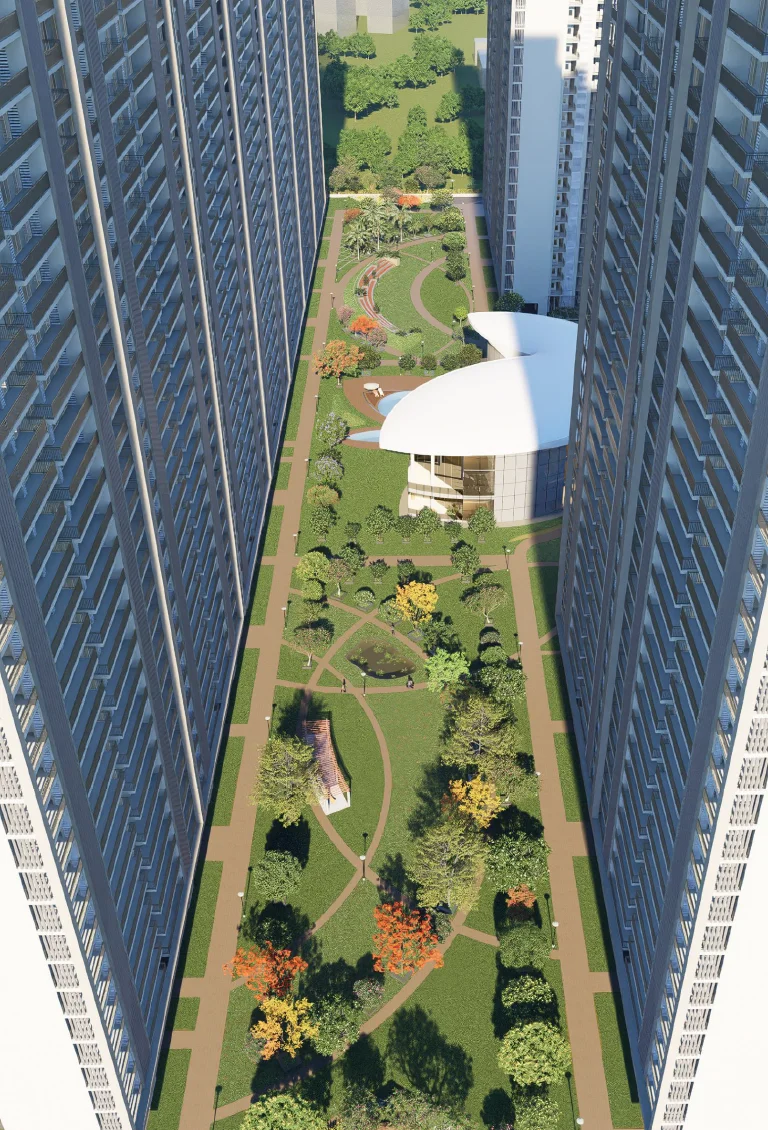
On the podium below, the jogging loop is in motion. Eight hundred metres of cushioned, lit, traffic-segregated track ring the central green. Six runners, by quarter past six, are spread across the loop at intervals that feel — without any of them having coordinated it — like a choreographed dawn. Two are doing intervals. One is walking with a dog the building manager knows by name. One is on a podcast. Two are running together, talking about a meeting at ten that one of them has not slept enough for.
The first hour of a Fab Luxe day is the one that compounds. The jog at 5:50 is not merely a workout; it is an infrastructure choice. A track that is cushioned, lit, segregated and patrolled is a track that gets used. A track that is improvised on a road around the boundary wall is a track that gets abandoned by November. The compound interest of small infrastructural decisions is what separates a residence that ages well from one that ages quickly.
Six Twelve AMThe chai that arrives in a porcelain cup
By six twelve the kettle on the thirty-second floor has whistled, but the chai itself, this morning, is being delivered. The resident — a paediatrician, fifty-one, who has been at Fab Luxe since handover — has booked a recurring 6:10 chai through the resident app. The delivery comes from the clubhouse cafeteria, on a porcelain cup with a saucer, on a small wood tray, by a staff member who has been with the assurance team since week one. There is a name on the order. There is a name returned.
The cost of this is small. Less than a daily latte in Mumbai. The benefit is not the chai. The benefit is the removal of one decision — the small grain of friction that, over a year, accumulates into the decision-fatigue that is the silent tax of urban life. You did not have to think about milk. You did not have to think about cardamom. You did not have to think about the dishwasher that needs unloading. The day starts with one fewer task than it would otherwise have started with, and that absence is the most valuable square foot of the apartment.
This is what a residential concierge is for. Not the dramatic favours — the lost passport, the urgent flight — though those happen too. The everyday, repeatable, dignified small acts. The chai. The newspaper folded on the doormat. The fresh kurta picked up from the laundry. The car warmed and brought to the portico at 8:55. The compounded sum of these is what residents at Fab Luxe will, without knowing why, describe in year three as peace.
Six Thirty AMThe mist on the Hindon and the herbs
The Hindon, on a winter morning, lays a thin white sheet over the eastern fields of Sector 4. From the eastern balconies of Towers 8 through 11, you can watch it lift and dissolve over the course of an hour. The sun, when it arrives over Greater Noida West around six forty in winter, breaks the sheet first at the high points — the Yamuna Expressway in the distance, the FNG Corridor closer — and then, like a slow tide, retreats from the lower ground.
On the podium, a gardener is turning over the herb beds. The herb garden, which the community kitchen draws from, is a small thing — about four hundred square feet of mint, basil, lemongrass, curry leaves, bay, ajwain, dhania and pudina. By 6:35, three residents have walked past it, and one has clipped a sprig of mint with permission of the gardener for a tea she will make at home. This is the kind of negotiation a thirteen-acre estate makes possible: the gardener and the resident know each other; the residence and the landscape are not in different conversations.
At the wellness deck, the yoga session begins. Ten residents in a column. The instructor — paid for, in the first three years, by the assurance programme — counts the breaths in Hindi, then English, then Sanskrit. The deck is on the second podium level. To the east, the Hindon mist. To the west, the silhouettes of Towers 1 to 4. Above, the unhurried sky. Below, eight hundred metres of jogging loop on which the morning's runners are now closing out their last laps.
Seven Fifteen AMThe fresh-air supply, and the study at first light
The fresh-air supply system in every Fab Luxe apartment is the most important piece of infrastructure that nobody will ever photograph. It runs through the night, on a low-energy setting, drawing in air from filtered intakes at podium level and exchanging it with the indoor envelope. By seven, the indoor reading on the kitchen wall panel is forty-six. The reading at the boundary wall is one hundred and ninety-two. The arithmetic of the difference is what residents have, by the second month, stopped consciously calculating — though the calculation is what they are paying for.
The study in a Fab Luxe apartment is a circadian space. The lighting is tuned to the sun. At 7:15, the desk lamp is at its coolest temperature — 6,000 K, blue-leaning, alert — and as the day moves towards noon it will warm by half a degree per hour. By dusk the same lamp will be at 2,700 K, golden, low-glare. This is not decorative lighting. It is circadian lighting, calibrated to the body's own clock, and it is the reason a 6 AM call to a London colleague does not produce, by 11 AM, the visible exhaustion of a Mumbai conference room.
A consultant on the thirty-fifth floor of Tower 4 is at her desk by 7:20. Her client this morning is in Frankfurt. The fibre is enterprise-grade — dedicated, not shared — and the encrypted call connects on the first try. The Bose noise-cancelling headphones are on the desk but unused; the study is sound-treated and the door is closed and the family is asleep. The seven AM hour, at Fab Luxe, is the most productive of the working day for the residents who have not yet had to commute to it.
Seven Forty AMThe school-bus choreography and the small triumphs
School buses arrive at the east gate from twenty to eight. The portico of Tower 9 has the highest concentration of schoolchildren. A nine-year-old in a striped tie is arguing with his mother about whether the homework folder is in his bag. The Golf Carta — the managed shuttle that runs from each tower to the gates — is at the drop-off. Two children whose parents have miscalculated the walk are catching the shuttle to make the bus. The mother of the nine-year-old is, by 7:48, alone again on the podium. She has the morning back.
This is the under-marketed feature of a managed estate. The quiet removal of small logistical defeats. The forgotten lunchbox handled by the concierge. The missed shoe found in the flat by housekeeping and walked to the gate. The bus driver who knows three families by name. None of this appears on a brochure. All of it is what the brochure is, in the end, selling.
By eight, the campus has reorganised itself. The runners are home. The yoga class has dispersed. The Senior Citizen Zone has opened — low-impact equipment, shaded benches, a chess set on a stone table that has begun, this winter, to draw a regular game between two retired engineers from Towers 5 and 7. The clubhouse cafeteria is in its breakfast service. The library, on the clubhouse third floor, is opening its slow morning hours.
Eight Fifty AMThe work-from-home commute that is ninety seconds long
The commute from a Fab Luxe apartment to the clubhouse co-working floor is ninety seconds on foot and sixty on a Golf Carta. The co-working floor occupies a generous portion of the second podium, with focus pods, sound-insulated booths, two open meeting rooms with booking plaques, and a pantry stocked through the assurance period. By 8:55, eleven residents are at it. Some have not been into a Delhi-NCR office in nineteen months. Their work, by every measurable metric, has not suffered.
The argument for the co-working floor was not, in the original brief, the obvious one. It was not the pandemic. It was the second-pandemic question — the recognition that knowledge work, post-pandemic, would oscillate between home and elsewhere, and that the elsewhere should not be a coffee shop with bad Wi-Fi. The clubhouse floor is the elsewhere. It is a forty-five-second walk from the breakfast table. It is engineered for a four-hour focus block. It is the most quietly important amenity at Fab Luxe for the forty-plus families whose work is now location-agnostic.
The morning, at the co-working floor, has its own etiquette. Conversations are taken to the booths. The pantry is for refills, not for chat. The first hour is silent. The Frankfurt call from Tower 4 has migrated, by 9:10, to a corner pod. The German on the other end has heard, by now, the same study-grade audio for three months and has stopped asking which office his consultant is in.
Nine Fifteen AMThe settled hour, and the return of birdsong
By a quarter past nine, the morning has resolved itself. The buses have left. The runners have cooled. The yoga has finished. The school-uniform forensics have been concluded. The campus, which an hour ago felt like an orchestra tuning, is now playing its working-day arrangement. The herb garden has had its eight visitors. The library has six. The bird park, a low-canopy zone planted with the consultation of an ornithologist, is loud. The bird park is always loud at 9:15. It is the hour that bulbuls and koels claim as theirs.
A morning, lived this way, is a small ceremony of subtraction. Fewer cars to park. Fewer queues to stand in. Fewer decisions to make about chai or shoes or homework folders. The architecture has done the negotiating for you, and the day begins with a margin you would not have had in a less-managed residence. That margin, multiplied by three hundred and sixty-five, is what you will, in five years, describe as your life having gotten quieter.
This is the mornings case for Forbes Fab Luxe Residences. Not the brochure photograph. Not the marble lobby. The repeatable, reliable, almost-boring excellence of a 5:50 to 9:15 window that has been engineered to give you back time. Two hours, every morning. Seven hundred and thirty hours, every year. A month, basically, restored to the calendar.
That is what a morning at Fab Luxe is finally for. The compounding of restored hours into a different kind of life. The mist on the Hindon will keep doing what mist does. The towers will keep reading the light. The herb garden will keep being clipped. The fresh-air supply will keep running. And the resident, sometime in the second year, will notice — without quite being able to say when it happened — that they have started, by their own choice, waking before the city. The architecture will have made a person of them they did not know they had agreed to become.
Walk a Fab Luxe morning with us.
Site visits begin at 7:30 AM by appointment. Walk the jogging loop, see the herb garden, sit on the wellness deck — and read the air, for yourself, against the gate.
Schedule a Private Tour →Frequently Asked
What time do most residents begin their day at Fab Luxe Residences?
The thirteen-acre campus comes alive between 5:30 and 6:15 AM. The yoga deck has its first session at six, the jogging track is busiest from 5:50, and the community kitchens open at six for residents collecting breakfast. The architecture supports an early-rising rhythm without imposing one.
Is the fresh-air supply system on continuously through the morning?
Yes. Every apartment carries a 100% fresh-air supply system that runs continuously. Through winter mornings — when external AQI in Greater Noida West can spike past 300 — the indoor reading typically holds between 35 and 60. The system is calibrated for circadian benefit, not just for cleanliness.
Can residents work from home effectively in the early morning hours?
The study in every 3 BHK and 4 BHK at Fab Luxe is designed for it. Circadian-tuned lighting, dedicated enterprise fibre and acoustic treatment make the early hours productive. Residents who run global teams find the 6 to 9 AM window particularly useful for European mornings.
Is there a butler or concierge service for morning chai delivery?
The Fab Luxe concierge — staffed 24 hours under the 3-Year Assurance Programme — coordinates morning rituals on request, including chai and coffee delivery from the clubhouse cafeteria, newspaper drop, and breakfast assembly from the community kitchen.
What is the AQI difference between the gate and a 32nd-floor apartment?
On a typical winter morning the difference is between 80 and 150 points. The boundary wall reading might be 220; the apartment reading 50 to 70. Higher floors read cleaner because of fresh-air supply, podium-level filtration and elevation above the road inversion layer.
Is the jogging track lit before sunrise?
Yes. The 800-metre jogging loop is lit for dawn and dusk use through warm low-glare luminaires. Surface cameras and security patrols cover the track from 4:30 AM onwards.