
The ambition of a residential concierge service is simple and almost impossible. It is to replicate, in a private home, the hospitality that a five-star hotel delivers to a paying guest — and then to quietly exceed it, because the resident is not a guest but a permanent member of the house. Most residential projects, even in the luxury segment, fail at this ambition. Not because the concept is hard to describe, but because the ongoing cost of staffing, training and process-building is too high to sustain beyond the marketing phase.
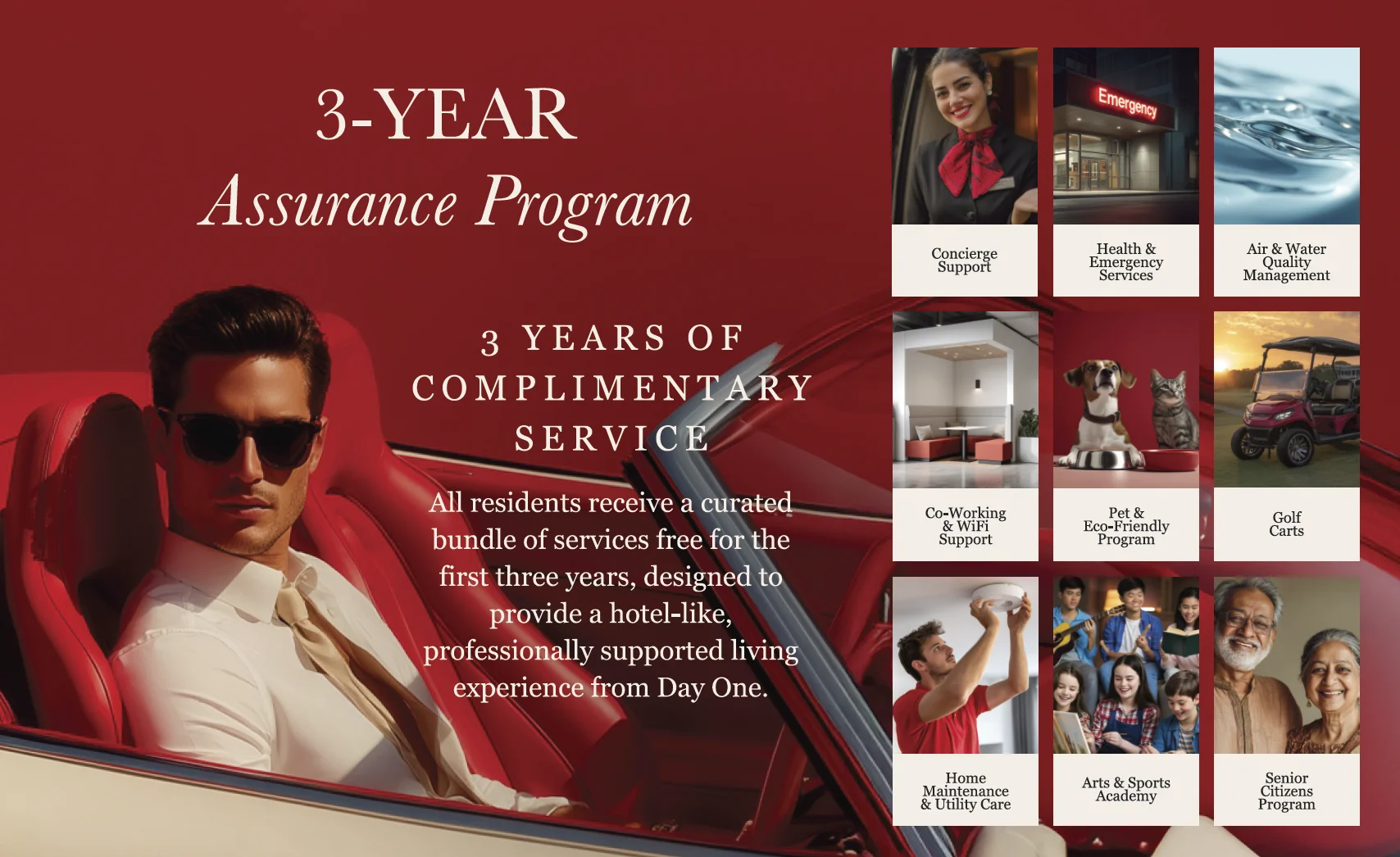
At Forbes Fab Luxe Residences, the concierge service is built into the 3-Year Assurance Programme — budgeted, contracted, and sustained from Day 1. This essay is about what a concierge in a luxury residence actually does, why it is more useful than a hotel concierge, and why the quality of this one service will quietly determine the quality of a resident's first year more than any other feature.
Layer OneThe request desk — the obvious work
The visible work of a concierge is request fulfilment. Book a restaurant. Arrange a car. Courier a document. Replace a watch strap. Send flowers. Coordinate a tiffin from the community kitchen. Book a wellness instructor for a private session. Hold a parcel during a three-week travel window. None of these are difficult individually. The concierge value is in the aggregation. A resident has perhaps forty such small requests across a month. An outside vendor or an app solves each in thirty to ninety minutes of negotiation. The concierge closes each in under ten, because the vendors are pre-vetted, the processes are standardised, and the resident's preferences are on file.
At Fab Luxe, the request desk is staffed from 7 AM to 11 PM, with an on-call line for the remaining eight hours. Requests are routed through the resident app, with a voice-call fallback. The app surfaces the request's status — received, in-progress, completed — so the resident is not repeatedly asking for updates.
Layer TwoThe quiet work — anticipation
A five-star hotel concierge anticipates. The car is ordered before the guest asks. The umbrella is at the door. The dietary note is on the kitchen pass. A residential concierge should do more of this, not less, because the resident's pattern is far richer than the guest's. Over a year, the concierge will have learned which restaurants the resident uses for anniversaries, which car type they prefer at the airport, which pharmacy they favour, whose medical appointments cluster on Tuesdays. This is called personalisation in the marketing copy. In practice it is just attention.
The anticipation work compounds. A resident who moves into Fab Luxe in April will, by the following April, have a concierge relationship that a first-time hotel guest could not purchase at any price.
Layer ThreeThe buffering work
Concierge exists, partly, to absorb friction the resident would otherwise absorb themselves. The plumber who did not show. The delivery that arrived while the family was out. The elderly parent who fell and needed a doctor at 11 PM. The guest who arrived without a confirmed taxi. The late-night dry-cleaning emergency before a morning flight. A well-run concierge service handles these, often without the resident knowing the buffer existed. The resident notices, instead, that their life is less scratchy than it used to be.
This buffering is what separates a residential concierge from a hotel concierge. A hotel concierge knows the city. A residential concierge knows the resident.
Layer FourThe event work
Once or twice a year, most residents will host something larger than a dinner. A birthday. An anniversary. A family gathering of twenty-five. A small professional event. The concierge, in these moments, becomes an event coordinator. Booking the banquet lawn or the multipurpose hall. Arranging catering from the approved vendors. Coordinating parking for visiting cars. Briefing the security gate. Organising the cleanup. Without the concierge, the resident would be running this operation from an Excel sheet and a WhatsApp group. With the concierge, the resident is a guest at their own event.
The difference is not convenience. The difference is that the event is enjoyable for the host. A birthday the mother did not enjoy is a birthday that did not land.
Layer FiveThe senior resident liaison
One dedicated member of the Fab Luxe concierge team serves as the liaison for senior residents. The liaison knows which apartments have elderly occupants living alone, which are on regular medication, which have children living abroad, which prefer a weekly check-in call over a daily one. The liaison coordinates the quarterly health camps, the Golf Carta priority bookings, the low-impact fitness schedules, and — critically — the emergency response in the rare cases it is required.
For families who are buying an apartment at Fab Luxe specifically so that their elderly parents can live independently, the senior liaison is the feature that makes the decision work. It is why the amenities matter less than the service that runs them.
Layer SixThe discretion
A concierge who cannot keep a confidence is not a concierge. Fab Luxe's team is trained on discretion protocols that are borrowed, with modifications, from the luxury hotel industry. Resident movements are not discussed. Guest details are not shared across floors. Personal requests are not volunteered in open spaces. The team is, in effect, the silent circulation of the residence — everywhere, almost invisible, never narrating.
Why the concierge matters more at a residence than at a hotel
A hotel guest can change hotels. A resident cannot change residence. The quality of a concierge is not, therefore, a nice-to-have feature — it is a structural condition of the resident's daily life. If it is good, every other amenity on the property multiplies in value. If it is mediocre, the property's marketing collapses against its own lived reality.
This is why we have contracted the concierge under the assurance programme rather than leaving it to post-possession RWA negotiation. It is why we have trained the team specifically for residential work rather than rotating them out of the hotel-hospitality pipeline. It is why the concierge, three years in, will be the feature residents talk about most and prospective buyers notice least on their first visit. Quiet, in the end, is what luxury actually sounds like. The concierge is the quiet.
Layer SevenThe concierge and the family crisis
A family crisis is where a concierge proves its value most sharply. An elderly parent who falls at night. A child who needs to be collected early from school because they are ill. A pet that has a medical emergency while the family is travelling. A water seepage from the upstairs apartment at 2 AM. These are the moments in which a residential concierge performs its most useful, least advertised work.
At Fab Luxe, the protocols for each of these scenarios are written, rehearsed, and integrated into the on-call rotation. The concierge team can dispatch a medical partner, arrange a vehicle, contact the family's designated emergency contact, coordinate with the security gate for external responders, and — crucially — absorb the anxiety that would otherwise fall on a family member who is themselves disoriented by the crisis.
The difference, measured across a year, is that a family at Fab Luxe has a named, reachable, accountable point of contact for the small disasters. In a standalone house, that contact is no one, or the Google search bar. This is the feature a prospective buyer does not ask about on the first visit and cannot imagine having lived without, by the end of the second year.
Layer EightThe continuity of staff
The single biggest quality determinant of a concierge service, five years in, is the continuity of the people who run it. A hotel concierge rotates out every eighteen months. A residential concierge, to be genuinely useful, must stay. Fab Luxe's operator has committed to a tenure-retention model — the concierge team is employed and compensated in ways that make three-year and five-year tenures the norm, not the exception. The residents who were welcomed on Day 1 should still be greeted by the same person on Day 1,095.
This continuity is what turns a concierge service into a relationship. It is the difference between a transactional service desk and a house team. It is also what makes the three-year assurance programme function as an assurance: the team that was trained and deployed at launch is the team that is still there when the RWA takes over, which means that the transition is not a reset but a handover.
See Forbes Fab Luxe in person.
Private site tours are currently available by appointment. Walk the landscape, read the brief, meet the project team.
Schedule a Private Tour →