
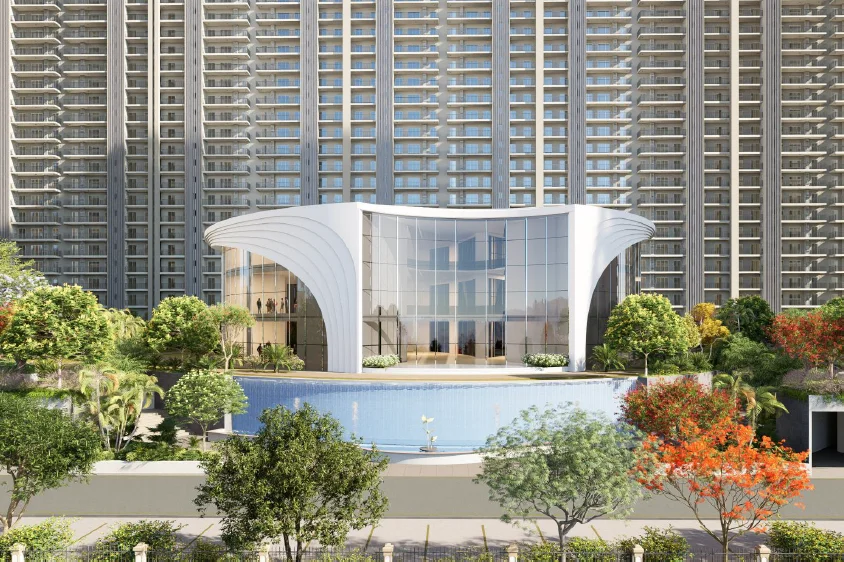
In Indian middle-class and upper-middle-class life, the clubhouse is a peculiar institution. It is not quite a club. It is not quite a resort lobby. It is not quite a living room. It is the place where a neighbourhood has negotiated, over the past thirty years, what a gathering looks like when it is not in a temple, not in a hotel banquet hall, and not on a particular family's terrace. At Forbes Fab Luxe Residences, the 35,000 sq ft clubhouse is the most important amenity on the site. Not because it is the largest, but because it is the ritual vessel.
This essay is about that ritual. What a clubhouse in an Indian luxury residence actually does, week by week and year by year, once the architectural photography has been shot and the project has settled into ordinary life.
Scene OneThe clubhouse as threshold
A clubhouse is, first, a threshold. It is the public face of a private life. When your cousin visits from Bangalore for a long weekend and you do not have four extra bedrooms, she stays in the guest suite attached to the clubhouse and walks over to your apartment for meals. When your college group of eight wants to celebrate a birthday and your dining table sits six, the private dining room at the clubhouse is booked at four hours' notice. When a business visitor is in town and you do not want them in your home, the lounge on the ground floor functions as a neutral meeting space.
The threshold function is under-discussed because it is invisible. But it is the single largest reason luxury apartment buyers in India pay a premium for a project with a serious clubhouse. The apartment becomes legible — a private home, not a compressed hotel suite — because the clubhouse absorbs the parts of life that would otherwise overflow into it.
Scene TwoThe ritual of the Sunday brunch
By the third month of occupancy, a clubhouse in a well-run residential project has developed a rhythm. On Sundays at Fab Luxe, the pool-side cafe will host brunch from ten to one. Seventy or eighty residents will drift through. The children will be in the adjacent kids' zone. The grandparents will arrive last, having done their walk first. Tables will rearrange themselves according to conversations that started that week. A marriage, a job change, a college admission — these pieces of news will circulate at a pace that is faster than the residents' WhatsApp groups but slower than a phone call.
This ritual cannot be designed by architecture alone. It requires an operator. The 3-Year Assurance Programme funds a culture coordinator whose job, for three years, is to make sure the clubhouse has a Sunday. After that period, the Resident Welfare Association inherits the calendar.
Scene ThreeThe quieter weekday clubhouse
Monday through Friday, the clubhouse behaves differently. The co-working floor is full from nine to seven. The library has a small, loyal clientele. The gym peaks at six AM and seven PM. The art academy studios are busy after school. The yoga deck runs three sessions. The main pool is quiet — the serious swimmers come at dawn; the recreational swimmers come at dusk.
The weekday clubhouse is the infrastructure of the ordinary day. It is what separates a residence from a dormitory. It is the reason the apartment upstairs can be 3,300 square feet and not 4,300 — because the extra thousand feet lives downstairs, in the common rooms, and is shared with nine hundred other residents instead of sitting empty two hundred days a year.
Scene FourThe big night: wedding, festival, funeral
Twice or three times a year, the clubhouse takes on its largest role. A wedding baraat that begins at the banquet lawn. A Diwali evening that fills the amphitheatre and the poolside lawn with six hundred residents and their guests. A condolence gathering for a resident's parent, held in the multipurpose hall with the blinds drawn and the catering reduced to tea and biscuits. These are the big nights. They are the moments the clubhouse carries the weight of a community.
A project that has not thought about how its clubhouse handles a wedding or a funeral will fail its residents on both. Fab Luxe has. The banquet lawn can be tented for rain. The multipurpose hall has a separate entrance for grieving families who do not want to walk past a yoga class. The amphitheatre has programmable lighting for a Diwali performance and programmable darkness for a candlelight memorial.
Scene FiveThe stratified social layer
A clubhouse in a 632-residence project is necessarily stratified. The twenty-somethings will find each other at the gym and the youth corner. The thirty-to-forty-somethings will gather at the pool and the co-working floor. The fifty-and-above group will claim the library and the board game area. The wellness rituals — yoga, pilates, walking groups — cut across all of these. The children absorb the amenities that no adult has time for.
This stratification is not a design problem. It is a social success. A clubhouse that pretends to flatten its users into a single demographic serves none of them. Fab Luxe's clubhouse is deliberately composed of many rooms, each tuned for a specific generation and a specific mood. The residents self-sort, and the architecture accommodates them.
Scene SixThe hospitality of the non-member
A private club excludes non-members. A residential clubhouse includes them — carefully. Your visiting parents, your staff, your delivery personnel, your children's friends from another project, your business guests. A well-run residential clubhouse has a language for each of these, and a procedure. The concierge desk at Fab Luxe will register a guest, issue a temporary access card, direct them to the appropriate amenity, and log their departure. This is quieter than a hotel lobby and more efficient than a private club.
The result is that, across a year, a resident of Fab Luxe will have hosted perhaps thirty or forty people who, in a standalone house, would have had to be absorbed by the private rooms. In the clubhouse, those encounters are buffered — by space, by staff, by the ritual of the clubhouse itself.
Why the clubhouse is the soul of the residence
If you took every amenity at Fab Luxe and rebuilt them somewhere else — the Sports Academy, the Art Academy, the gardens, the walkways — but left out the clubhouse, you would have a well-appointed residential project that did not, quite, know what to do with itself on a Sunday morning. The clubhouse is what organises the other sixty-three amenities into a social year. It is the reason a resident's week has a rhythm instead of a schedule, a shape instead of a list.
This is why the clubhouse is the most important amenity at Fab Luxe. Not because of its square footage. Because of the social architecture it makes possible. A ritual, in India, is a container for the way a group agrees to be together. The clubhouse, well run, is such a container. The clubhouse at Forbes Fab Luxe Residences is built to be one.
Scene SevenThe operator's quiet role
A clubhouse without an operator becomes a corridor within six months. This is the unspoken truth of Indian residential life. The brochure shows a lounge with jazz on a low speaker; the reality, eighteen months later, is a lounge with a flickering tube light and a notice about unpaid maintenance dues. The difference is not architectural. It is operational. The assurance programme at Fab Luxe staffs the clubhouse with a full operations team — a facilities manager, a cultural coordinator, a concierge liaison, housekeeping rotations, and a maintenance protocol that is scheduled rather than reactive. Each of these roles, across a year, costs money. None of them is romantic. All of them are what keeps the Sunday brunch a Sunday brunch rather than a memory.
This is the reason the clubhouse, as a ritual, has a shelf life that exceeds the launch enthusiasm. It is operated. The residents, relieved of the burden of operating it themselves, can simply use it. That is what a residential clubhouse, at its best, offers the city-dweller: a well-staffed, well-programmed, well-maintained common room that they do not have to run. It is a quiet form of luxury, and it is the luxury residents notice most in their second year.
See Forbes Fab Luxe in person.
Private site tours are currently available by appointment. Walk the landscape, read the brief, meet the project team.
Schedule a Private Tour →