
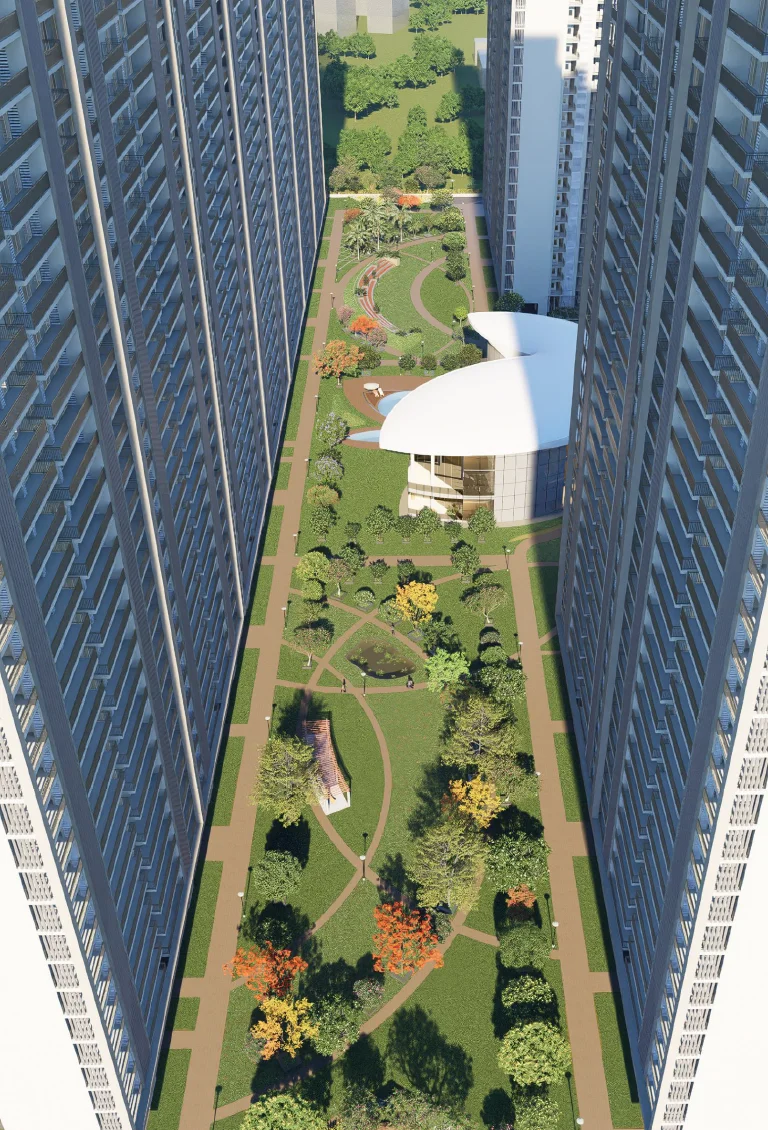
A day at Forbes Fab Luxe Residences does not begin with an alarm. It begins, if you are paying attention, with the quality of the air. The filtered morning at the thirty-second floor has a weight to it — cooler than the garden below, softer than the street. You notice this the way you notice clean linen after travel: by its absence of friction.
This is an unhurried tour of an ordinary Tuesday across the thirteen-acre campus in Sector 4, Greater Noida West. Not a marketing brochure. A day. From six in the morning to midnight, recorded in the sequence it actually unfolds for the people who will live here from December 2028 onwards.
Chapter One06:12 AM — The hour before the world
The first person you are likely to meet is the jogger. She is fifty-four, retired from a career in finance, and she has discovered — to her own surprise — that she has become a morning person since moving in. The reflexology path around the central green is where she walks for the first twenty minutes; then the jogging track, eight hundred metres of cushioned loop that circles the podium garden. By the time she finishes, the light has changed three times.
On the thirty-fifth floor of Tower 6, a chef is grinding coffee on a marble slab in a 3,300 sq ft four-bedroom apartment. The ventilation system hums at the lowest setting, a frequency you stop hearing after the first week. The AQI reading on the wall panel — and every apartment has one — shows a number that the world outside the compound has not been able to offer since October.
07:40 AM — The school-bus choreography
At the portico of Tower 9, a boy in school uniform is arguing with his mother about whether he needs a sweater. The bus is at the east gate. The Golf Carta — one of the managed shuttles — is idling at the drop-off, ready to take two children whose mothers have miscalculated the walking time. This kind of friction, the developer's brief decided early, should be designed out.
The clubhouse is not open yet. The yoga deck, on the other hand, has been in motion since six. Ten residents, all older than fifty-five, are halfway through a sun salutation led by an instructor whose job is paid for, for the first three years, by the Fab Luxe 3-Year Assurance Program.
This is the under-discussed feature of a well-managed residential tower: the quiet removal of the small logistical defeats that accumulate into exhaustion. Forgotten lunchbox. Missed bus. Ambiguous bus stop. The resident app handles the first, the concierge the second, the layout of the portico the third.
Chapter Three09:00 AM — The work-from-home commute
The commute to the co-working floor in the clubhouse is ninety seconds on foot and sixty on a Golf Carta. The enterprise fibre is dedicated, not shared. The focus pods are sound-insulated. The meeting rooms have booking plaques that turn amber when a session is about to run over. A consultant on a call to Singapore does not sound, to the client on the other end, like someone calling from home.
This matters. The pandemic proved that knowledge work does not need a city office to function; it did not prove that a typical Indian residence is an acceptable substitute. A well-designed amenity like the managed co-working floor at Fab Luxe closes that gap.
Chapter Four11:30 AM — The audit of small pleasures
By late morning, the campus has settled into its weekday rhythm. The herb garden has a gardener turning over the mint bed. The butterfly garden, barely three months old, is already working: three species that the landscape consultant was not expecting have made it a regular stop. A pair of painters from the Art Academy are setting up on the edge of the lily pond.
The Lily Pond, incidentally, is one of those design decisions that sounds decorative and turns out to be structural. It is a cooling feature. The microclimate around it, in the Indian summer, is three to four degrees below the paved zones. Children figure this out before adults do; they congregate there.
The landscape programme at Fab Luxe — orchards, mangroves, a xeriscaping demonstration, a herbs garden, a butterfly zone, a bird park — is not a sequence of photograph backgrounds. It is an ecological argument conducted through plant choice. Over seasons, it compounds.
Chapter Five01:15 PM — The lunch that was not ordered
A delivery app is, at Fab Luxe, a ghost of the outside world. The community cooking kitchen, the tiffin service coordinated via the concierge, and the restaurant partnerships managed through the resident app mean that lunch for a resident who is working from the co-working floor involves a walk of four minutes. A woman from the twelfth floor is at the community kitchen, finishing a bhindi for a grandson who will be home at three. She has booked the veg kitchen for ninety minutes, app-confirmed, cutlery provided.
This is what managed living means when it is built into the architecture rather than added as a service line. The food flows. The domestic labour finds its place. The apartments upstairs remain clean because the dirtiest part of the day has been absorbed by a purpose-built space two floors down.
Chapter Six03:45 PM — The homework hour
Children return. The Art Academy opens its afternoon sessions. The ceramics studio — six wheels, one kiln — begins the week's throwing class. In the sports academy, a coach in a tracksuit the colour of a Greater Noida sky is setting out cones for the under-twelve cricket clinic. Seventeen children, nine of them girls, are arriving in varying states of readiness.
The Sports Academy is a full-building commitment — not a corner of the clubhouse. Across a child's week, it will absorb what, in an ungated neighbourhood, would be a chain of car rides between three suburbs.
Chapter Seven06:40 PM — The light that makes the towers cinematic
At ten minutes to seven, the eleven towers do something photographers describe as "reading" the light. The western facades go copper. The lily pond turns the colour of tea. The amphitheatre, which has been empty all afternoon, begins to fill for a Thursday poetry reading that the culture coordinator has programmed for residents and a small guest list.
This is when a community announces itself. Not at breakfast. Not at lunch. But in the soft hour between work and dinner, when the day has been done and the evening has not yet begun. On the banquet lawn, a birthday setup is being laid out for a seven-year-old whose grandmother flew in from Jaipur yesterday. The concierge has handled the cake, the balloons, the parking for twelve cars.
Chapter Eight08:25 PM — The pool is for night swimming
The swimming pool is lit from below. Two residents, one a physiotherapist and the other a retired civil servant, are doing lengths at a pace that is a conversation rather than a workout. On the cabana edge, a couple is sharing a pot of jasmine tea; the restaurant on the clubhouse ground floor has sent it up. The AQI display on the pool pavilion reads forty-three. The world beyond the boundary wall reads two hundred and ten.
This is the Fab Luxe case in one line: the difference between those two numbers, day after day, is what you are buying. Everything else — the marble, the views, the thirty-fifth-floor balconies — is what arranges itself around the clean air.
Chapter Nine10:50 PM — The building sleeps
The library in the clubhouse is still lit. Two people at separate desks. A third on a sofa with a paperback. The night-shift security rotation is handing over at the east gate. The Golf Carta fleet is charging. The housekeeping office is updating the next day's tasks on the shared board. In a four-bedroom on the sixteenth floor, a child who has cried himself to sleep is finally asleep, and his mother, for the first time today, has poured a glass of wine and walked out onto her balcony. The air is forty-four. The city is a constellation.
This is the accountability of a managed residence: that the day ends as intentionally as it began. Not a chaotic surrender at midnight — an arrival. Not a collapse — a closure.
What a day at Fab Luxe quietly adds up to
Lived for a year, these days compound. The jogger has lost six kilos without trying. The consultant has closed two accounts she would not have closed if her work-from-home setup had been the guest bedroom. The boy has made four friends in his Art Academy batch and speaks about watercolour in a way no seven-year-old in the family has spoken about anything. The grandmother has made her peace with an apartment that is smaller than the house in Jaipur but easier to love.
None of this is visible in a price list. None of it appears on a floor plan. It is the invisible product of thirteen acres, eleven towers, 632 residences, sixty-four amenities, an AQI system that actually runs, and a three-year assurance that the lifestyle shown on Day 1 will still be the lifestyle on Day 1,095.
That is a day in the life at Forbes Fab Luxe Residences. There will be a thousand of them between possession and the first serious review of this project. We are comfortable being measured by what those days contain.
Walk one of these days with us.
Private site tours are currently available by appointment. Meet the project team. Read the brief. Walk the landscape.
Schedule a Private Tour →