
The most expensive thing in a luxury apartment is the thing you cannot see. The marble, the joinery, the chandelier — these are all variations on the same category of visible spend. The indoor air is a different category entirely. It cannot be photographed. It cannot be exhibited at a sales event. It is unmentioned in every competing project's marketing, because no one has built for it. And yet, over the years a family actually lives in a home, it is the single amenity that compounds the most into health, sleep, mood, and the plain feeling of being at ease indoors.
This essay is about why well-managed indoor air is the quietest form of luxury, why Forbes Fab Luxe Residences has built its entire identity around it, and what that identity looks like in the lived experience of a winter month in Greater Noida.
Frame OneThe AQI problem in the NCR
From October to February, the ambient Air Quality Index in the National Capital Region routinely exceeds 300 and occasionally exceeds 500. The WHO guideline for PM2.5 is an annual average of 15 micrograms per cubic metre. Delhi's average is north of 100. A child growing up in the NCR, without any indoor filtration, is breathing — and this is the conservative estimate — the equivalent of several cigarettes' worth of particulate matter every day.
This is not an abstraction. It is the single largest public-health problem in the region, and it is the reason every serious luxury residence being built in the NCR should, and usually does not, take indoor air as its first design parameter.
Frame TwoThe Fab Luxe system
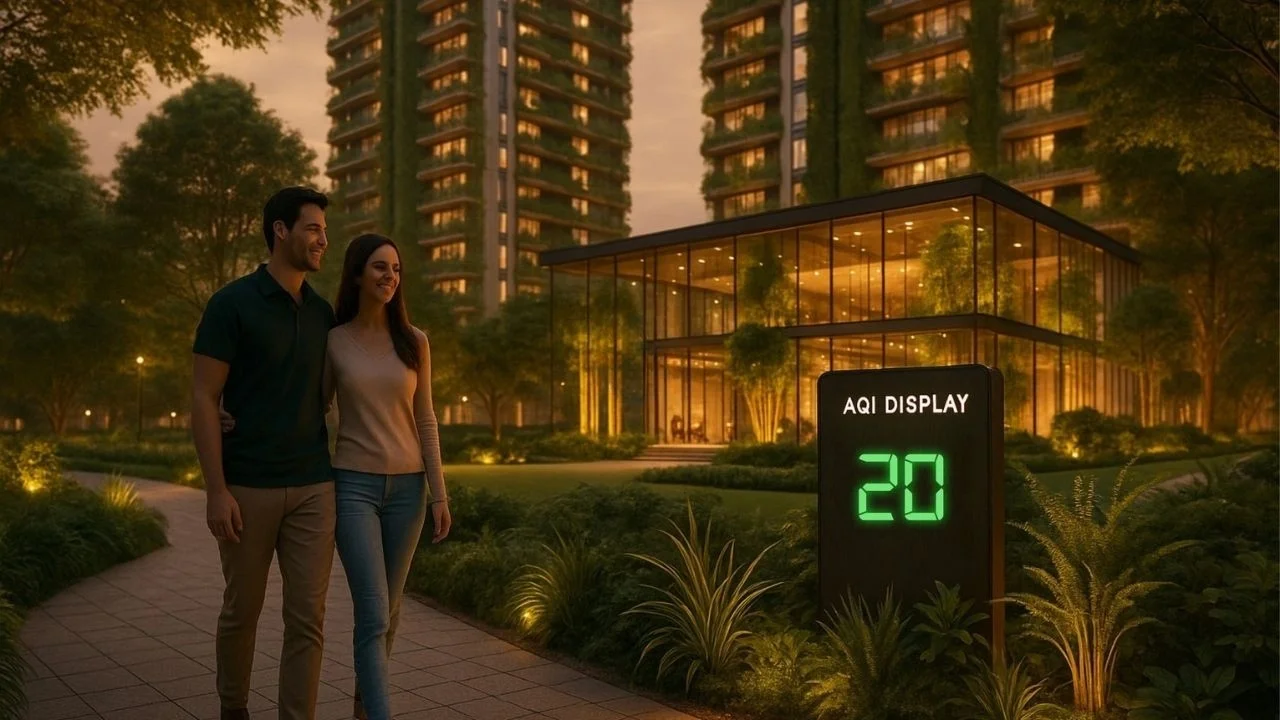
The system at Fab Luxe has three layers. Outdoors, the campus has distributed AQI towers that actively filter ambient particulate across the central green and the podium. Sensors report the outdoor AQI live. Between outdoors and indoors, each apartment has a positive-pressure fresh air unit. The apartment is, in effect, very mildly pressurised against the outdoor air, so that filtered air moves from indoors to outdoors through gaps rather than the reverse. Indoors, each apartment has a ventilation system with HEPA-class filtration on the intake.
The result is that the indoor AQI in a Fab Luxe apartment tracks the outdoor AQI by a very narrow margin during the worst parts of winter. Residents with pre-existing respiratory conditions — asthma, allergic rhinitis, COPD — report measurable differences in symptom frequency and severity in their first year. Families with young children report fewer winter missed school days. These are anecdotal now; they will be systematised as the project matures.
The UPVC window detail
A fresh air unit is only as good as the envelope it is conditioning. Every apartment at Fab Luxe has UPVC windows, not aluminium or wood. UPVC, at the frame level, seals more tightly, does not warp with humidity, and does not leak air the way a less precisely manufactured window does. This is a small specification decision. It is also the decision that keeps the ventilation system's work from being undone by the envelope.
This is what "well-managed" means in the context of indoor air. Every element — the AQI tower, the fresh air unit, the HEPA filter, the UPVC window, the positive pressure — is part of a single system. Miss one and the system degrades by a multiple of its own contribution.
Frame FourThe sound of clean air
There is a sound that clean indoor air makes. It is not the hum of the air handler — which, at the lowest setting, is inaudible from two metres away. It is the absence of sound. An apartment where the family is not clearing its throat, not sneezing, not coughing, not running the humidifier to counteract the drying out from constant throat irritation. A night in a bedroom where both parents sleep through, instead of waking at two for water and nasal relief.
Residents who have lived in managed-air apartments describe this as the single biggest quality-of-life change of the move. Not the marble. Not the view. The silence of bodies at rest.
Frame FiveThe dust that does not arrive
In the NCR, the most visible marker of indoor air quality is the rate at which furniture gathers dust. In a typical apartment, the television console needs wiping every other day. Bookshelves develop a film. Curtains carry particulate. At Fab Luxe, the rate is roughly halved. Not because the apartments are cleaner — though the housekeeping, under the assurance programme, is more consistent — but because the indoor air carries less particulate in the first place.
This is the aesthetic of clean air. The stillness of surfaces. The way a bookshelf does not develop the grey film that turns every piece of paper slightly less white by April. The way the black lacquer on a concert piano continues to read black.
Frame SixThe child's lungs
If this essay has a central argument, it is this: a child's lungs are still developing through adolescence. The particulate exposure in the first eighteen years of life sets the baseline respiratory health for the next sixty. This is what makes indoor air, in a city like Greater Noida, not merely a luxury but a developmental intervention.
We do not, in marketing, like to dwell on this. It is sombre and difficult. But it is the truthful case for the infrastructure. A child at Fab Luxe, across twelve years of childhood, will inhale a meaningful multiple less particulate than a child in an equivalent apartment without the system. Across a lifetime, the difference is not recoverable by any later intervention. The house is the intervention.
Quiet luxury, literally
"Quiet luxury" has become a fashion term. In the context of a home, it means something more structural. It means a luxury that does not announce itself — that makes no claim on the eye — but that shifts the body toward ease, steadily and without ceremony. Well-managed indoor air is the purest example of this. It costs considerably more than a marble lobby. It photographs as nothing. And it is what a resident of Fab Luxe will defend, ten years in, as the single best decision of the purchase.
That is the promise. Not the air as a feature. The air as a standard. The air, every day, for every one of the 632 residences. Quietly. Unmarketed. Underneath the whole building.
Frame SevenThe maintenance of the invisible
An air management system is only as good as the maintenance protocol that keeps it running. A HEPA filter that has not been replaced in eight months is a HEPA filter that has stopped doing HEPA's work. A sensor that has drifted out of calibration is reporting numbers that mean nothing. An AQI tower that has a clogged intake is a landscape feature, not an engineering one.
At Fab Luxe, the maintenance of the air infrastructure is written into the 3-Year Assurance Programme. Filters are replaced on a schedule, not on request. Sensors are recalibrated quarterly. The fresh air units in every apartment are serviced annually, with reports shared with the resident. The AQI towers on campus are audited by an external partner twice a year. This is not glamorous work. It is the difference between a working system and a system that was working at handover.
The under-discussed feature of the assurance programme, therefore, is not the list of services — it is the discipline of maintenance. A luxury home that is promised clean air is a luxury home that is also promised a maintenance team that will keep it clean. Fab Luxe has contracted for this across the first three years, which is the window in which most Indian residential projects quietly abandon their wellness infrastructure. After three years, the RWA inherits the contracts, the vendors, and the playbook. This is how an invisible luxury stays invisible — it continues to work.
See Forbes Fab Luxe in person.
Private site tours are currently available by appointment. Walk the landscape, read the brief, meet the project team.
Schedule a Private Tour →