
There is a narrative, common in Indian family life, that a child does best in a standalone house with a garden, a dog, and the freedom to run in and out without passing a security gate. It is a romantic narrative, and it contains some truth. It also misses a great deal. A well-designed luxury residential tower — a tower in a managed, amenity-dense, pedestrianised, vertical community — can offer a childhood that is, in measurable and unmeasurable ways, richer than the standalone house of the same family's memory.
This essay is about what it is like to grow up in such a tower. Not in the marketing sense. In the ordinary sense. The mornings, the afternoons, the friends, the risks, the freedoms, the boundaries, and the long arc of what a child at Forbes Fab Luxe Residences will carry forward from this childhood into adult life.
Age One to ThreeThe toddler who can walk anywhere
The thirteen-acre campus at Fab Luxe is pedestrianised. Vehicles are on the periphery; the interior is for walking. A toddler, from the moment she can walk, has eight hundred metres of jogging track, a kids' pool, a dedicated toddler zone, a sculpture court, a herb garden, and a butterfly garden that she can reach without crossing a road. The grandmother, who is the most common companion at this age, can manage this geography without exhausting herself.
This is the under-discussed geographic freedom of a managed residential community. In a standalone house in a Delhi suburb, a toddler's outdoor time is constrained by the perimeter of the garden and the hazards of the street beyond. At Fab Luxe, the perimeter is the whole thirteen acres, and there are no streets.
Age Four to SevenThe friendship cluster
By age four, the child has identified three or four other children in the neighbouring towers. By age seven, there are fifteen. The kids' amenities — the Maze Runner, the Adventures Play area, the swimming pool, the art academy's foundational classes, the early sports coaching at the Sports Academy — create natural congregation points. The children do not need their parents to schedule their friendships. The friendships form geographically, in a way that apartment-complex living in a disconnected mid-rise can rarely replicate.
The Art Academy's junior track, in particular, functions as a social spine for this age group. A child who starts pottery at five and continues through eight will know, by sight and by name, every other child in the residence who has been through the same programme — fifty or sixty of them over those three years. This is the closest an Indian apartment building will come to the childhood of a small village, minus the violence and plus the plumbing.
The independent afternoon
At eight or nine, the child is allowed to walk to the clubhouse alone. To the Art Academy, alone. To the Sports Academy, alone. To a friend's apartment in Tower 5, alone. The security of the campus — the CCTV coverage, the secured gates, the vetted staff, the concierge's logging of movement — makes this possible in a way that most Indian neighbourhoods do not.
Independence, at this age, is psychologically formative. A child who walks to her own pottery class is a child who is building agency. A child who is driven, supervised, and deposited at every activity is building something else — often ability, but not agency. Fab Luxe's campus design is deliberate about this. The security is invisible. The freedom is visible. The child feels, from age eight, that she owns a piece of her own day.
Age Thirteen to SixteenThe teenager's negotiation
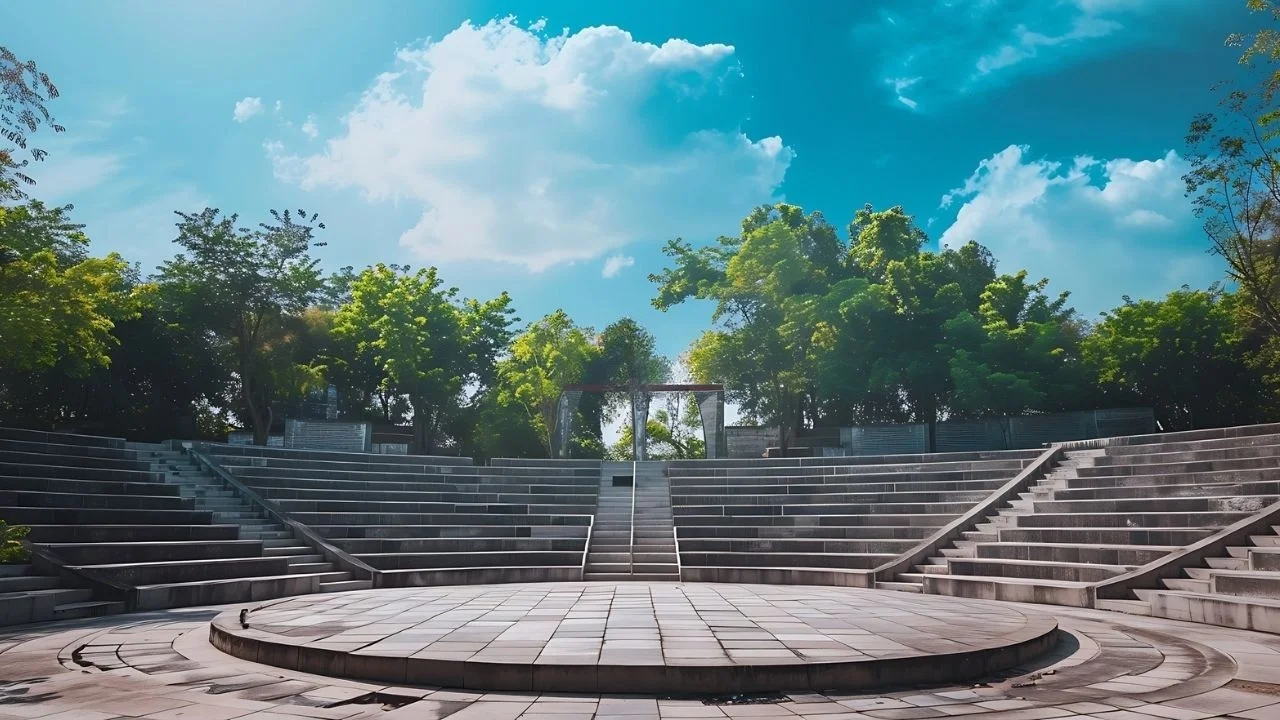
The teenage years are when a residential community is tested hardest. A teenager needs privacy, peer group, semi-structured space, and the option of disappearing for an hour. The Youth Corner, the library, the swimming pool at odd hours, the amphitheatre as an informal hangout, the sports academy as a training ground — these are the spaces the teenager will negotiate with her parents over. The parents will want more structure than the teenager will want. The architecture is designed so that both get enough.
Crucially, at this age, the peer group is on-campus. The late-night study session with three friends is possible without a parent driving four children across town. The birthday that unfolds at the amphitheatre is a birthday the parents do not have to drive home from. The first awkward party is a party that happens in a supervised multipurpose hall, not an unsupervised friend's house.
Age Seventeen onwardThe leaving, and the coming back
At seventeen or eighteen, the child leaves. College, usually; occasionally a gap year. The residence becomes the place she comes back to. This is where a well-designed residential community plays a longer role than most parents initially anticipate. The apartment is still there. The childhood friendship cluster is still partly there — some have left, some are still present, some are home for summers. The campus has a rhythm the returning young adult knows.
A home to come back to is not the same as a house to grow up in. Both are valuable. Most families underestimate the first when they are focused on the second. Fab Luxe is deliberately designed to be both.
Across all agesThe air, again
None of this works if the child grows up with the lungs of a chronic asthmatic because the air in the NCR has been unmanaged in her bedroom for eighteen years. The managed indoor air at Fab Luxe is, in this essay's argument, a developmental intervention. A child's respiratory baseline is set in the first two decades of life. The Fab Luxe envelope is built to protect that baseline.
This is the central and quietest case for a managed luxury residential tower, in the NCR specifically: the air. Everything else is the recreation. The air is the floor.
A childhood that is not apologised for
The old narrative — that the city child is somehow deprived of the real childhood of the village or the suburb — is out of date. A child at Fab Luxe will grow up with sixty-four amenities, fifteen ecologies, a professional sports academy, an art programme that includes a kiln and a printmaking press, a community of several hundred children across her childhood, and an air quality profile materially better than the NCR's baseline. This is not a lesser childhood. It is a different one, and — for a certain set of values — a better one.
The argument of this essay is not that every childhood should be a tower childhood. It is that, at Fab Luxe, the tower childhood has been designed with the care that the standalone-house childhood was designed with a generation ago. A child can be raised here, across every stage of development, without apology. That is a serious claim, and the architecture is built to honour it.
Across all ages, continuedThe friendships the child will carry
The social density of a 632-residence tower is unlike anything a standalone-house childhood produces. A child at Fab Luxe will, across her first twelve years, have regular contact with perhaps eighty other children — not all of them close friends, but most of them familiar. This is a larger social horizon than most Indian urban childhoods offer. The friendships made at the Sports Academy, the Art Academy, the swimming pool, and the Amphitheatre are friendships with a longer half-life than the friendships of a standalone-house childhood, because the geography is shared across years.
When a child at Fab Luxe leaves for college at eighteen, she leaves a friendship cluster that will still, a decade later, meet at weddings in the amphitheatre of their youth. This is the social compound interest of a well-designed managed residence. It is not something a buyer asks about in the first visit. It is something a resident values increasingly across the tenth year, the twentieth, the lifetime.
See Forbes Fab Luxe in person.
Private site tours are currently available by appointment. Walk the landscape, read the brief, meet the project team.
Schedule a Private Tour →