
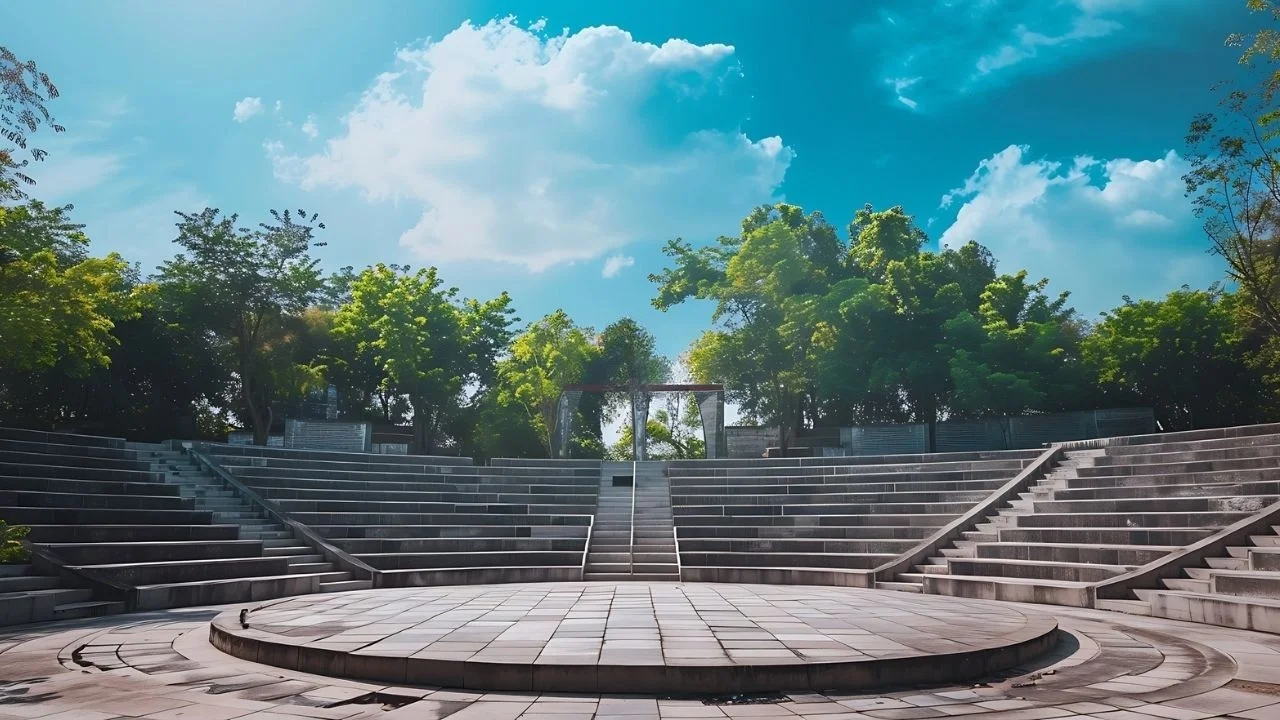
It is five-fifty in the morning at Forbes Fab Luxe Residences. The eastern light is pearl, not gold; the campus is mostly silent. A coach in a navy tracksuit is opening the gate to the lawn tennis court, restringing a racquet from the night before. A father and son in their batting whites cross the cushioned jogging track on their way to the cricket nets, the boy's pads slightly too big for him still. Two women begin a slow loop of the running track, talking about a school admission. The basketball backboards have just been wiped down. The skating rink is being mopped dry. The day, in the Sports Academy, has already begun.
The Sports Academy at Fab Luxe runs across twelve disciplines, on a 13-acre campus in Sector 4, Greater Noida West. It is not a side amenity. It is a parallel programme — coached, scheduled, regulation-sized, and run by full-time professionals retained for the first three years under the Forbes 3-Year Assurance Programme. The argument of this essay is that a sports academy inside a residential complex is not a luxury feature; it is the single decision most likely to predict whether a child raised on this campus develops a sport. It is also, in adulthood, the decision most likely to predict whether the resident is still moving in year ten.
The BriefWhy a sports academy was argued for, not added
In Indian residential practice, sports facilities are usually a residual decision. A tennis court is found wherever the landscape leaves space. A cricket net is squeezed against the boundary wall. A basketball half-court is painted next to the parking ramp. The result is that none of the surfaces are coached, none are leagued, and within twenty-four months most are no longer maintained. The court remains a court only on paper. By month thirty, residents drive forty minutes to a paid academy elsewhere because the home court has stopped being a place where one wants to play.
The Fab Luxe brief refused that pattern. The argument went like this. A child taught a sport from age six to fifteen will, on average, retain that sport into adult life. A child who is taught a sport at home — twenty steps from the apartment — will, on average, log three to five times more practice hours than a child who is driven to it. An adult who has a coached league at home will, on average, sustain weekly play through their forties and fifties at a rate that no-one driving to a club will match. The compounding logic of a home academy is therefore not incremental — it is structural. Hence the decision to commission, fund and staff a full sports academy on campus, not as an amenity but as a programme.
What you'll find here
- Lawn tennisTwo ITF-regulation courts, acrylic
- BasketballFull + half FIBA-spec court
- Cricket netsPractice nets, machine-compatible
- Box cricketFloodlit, evening leagues
- BadmintonAir-conditioned, sprung wood
- Table tennisPro tables, dedicated room
- SquashGlass-back regulation court
- BilliardsPremium tables, lounge
- VolleyballSand court, shaded seating
- Skating rinkResin surface, junior clinics
- Outdoor gymWeathered hardwood equipment
- Jogging track800 m cushioned, floodlit
- Yoga / ZumbaElevated deck, instructor-led
- Senior zoneLow-impact, dedicated path
Two courts, and a small army of seven-year-olds
The two lawn tennis courts at Fab Luxe are built to ITF-regulation dimensions, finished in professional acrylic, and floodlit for evening play. They sit on the north-east face of the campus, sheltered from the prevailing winter wind by a planted bund. The east court is, as a rule, the coaching court — junior clinics in the morning, group lessons after school, adult league in the late evening. The west court is the open court — bookable, walk-in, doubles-friendly, with seating and a small umpire's chair under a magnolia.
The coach roster, retained under the assurance programme, runs a Saturday clinic for children aged six to twelve and a Sunday adults' programme for absolute beginners through to club-level. By the second year, the academy expects to be running an inter-tower junior tournament; by year three, an inter-society league with the neighbouring complexes. The court that produces a player is not the court with the best resin. It is the court that is on the way to school. The Fab Luxe tennis programme is built on that single architectural decision.
CricketPractice nets, and the sport that defines the campus
Cricket, at Fab Luxe, runs on three surfaces: the practice nets, the box-cricket pitch, and the central green for occasional gully games. The nets are full-length with bowling-machine compatibility — a senior batsman can take a hundred deliveries in forty minutes, alone, with a coached eye reviewing the footage on the academy app. The box cricket pitch is the social engine of the campus. By eight in the evening, in the cooler months, four to six teams are queued up for the next slot. The leagues run inter-tower in the first year, inter-block in the second, and a semi-formal Premier-League-style format by year three.
The maintenance discipline is structural. A net surface, unmaintained, is unusable within six months. The assurance programme retains a full-time pitch curator for the first three years; by the time the residents' welfare association takes over, the maintenance practice has been institutionalised. We have written elsewhere on why a residential complex needs a sports academy at all — the cricket facility is the most concrete example of why.
Basketball & Open SportsFull court, half court, and the after-school hour
The basketball facility runs to FIBA spec — a full-size court with regulation backboards and a separate half court for one-on-one and shooting drills. The full court hosts the inter-tower league on weekends; the half court is the after-school destination, where boys and girls aged ten to fifteen rotate through pickup games until the floodlights turn on at six. The volleyball court — sand, shaded seating, evening matches — sits adjacent. The skating rink, on a smooth resin surface, runs junior clinics on Saturday mornings and free skate on weekday evenings.
The architectural decision worth highlighting is the proximity of these three facilities to one another. A child who has come down for one sport on a Saturday afternoon will, by the end of the session, have rotated through two more. The campus is laid out for cross-pollination — the geometry of the boundary is such that no two facilities are more than ninety seconds' walk apart, and all are downwind of the AQI management infrastructure rather than upwind of the parking ramp.
Badminton, table tennis, and the room with the green felt
The indoor sports complex is housed within the 35,000 sq ft Grand Clubhouse, on the first floor. Two badminton courts are air-conditioned, finished in professional sprung wood, with adjustable lighting tuned to remove shuttle glare. The table tennis room contains four full-size pro tables and is the academy's most-used indoor facility — the demographic ranges from nine to seventy-nine and overlaps in surprising ways. The squash court is glass-backed, regulation-sized, and surprisingly under-booked at launch — a fact that, by year two, has tended to reverse, as a small dedicated user base produces the next generation.
The billiards lounge is the soft punctuation. Two premium tables in a low-lit, panelled room with leather seating. Adults only by social convention rather than rule. Conversations there, by year two, become the source of half the residents' welfare association's policy decisions — which is the under-marketed value of a billiards room in a residential community.
Track & Outdoor GymEight hundred metres, and the running of an ordinary morning
The jogging and walking track is, by use, the most loved single facility on the campus. Eight hundred metres in length, cushioned for joint protection, segregated from motor traffic, lit for dawn and dusk, lined with magnolia and palm. The track loops past the central green, the herb garden, the lily pond and the reflexology path — a five-loop morning run, at a moderate pace, takes twenty-eight minutes and includes a passage through every micro-ecology of the campus.
The outdoor gym, set near the eastern face of the track, contains weathered hardwood equipment for body-weight training. By 6:15 AM on most weekdays, eight to ten residents are using it — seniors on the chest press, a younger contingent on the pull-up bar, a yoga class in the elevated deck above. The Senior Citizen Zone connects directly into this corner of the campus, with shaded seating, a low-impact equipment cluster, and a dedicated walking path that loops at lower elevation than the main track.
How It OperatesThe coaching schedule, and the assurance backbone
The Sports Academy is run, for the first three years from possession, under the Forbes 3-Year Assurance Programme. A full-time academy director coordinates a roster of coaches across tennis, cricket, badminton, basketball and skating. Coaches are professionals on salary — not interns, not freelancers — and the resident knows them by name within the first quarter. The programme covers age-group leagues, junior clinics, adult amateur ladders, and seasonal tournaments. Court bookings, league entries and personal coaching are managed through the resident app.
The fee structure is simple. Court access — tennis, basketball, badminton, the open courts — is included in maintenance. Coached sessions are billed per slot at internal academy rates. Group classes (yoga, Zumba, aerobics, junior coaching clinics) are no-charge during the assurance period. League entry fees are nominal, designed to populate rather than gate. The maintenance of the surfaces is the developer's responsibility through the assurance period; thereafter, the residents' welfare association inherits a fully institutionalised practice.
Design IntentThe architectural argument for putting it on the way to school
The architectural philosophy of the Sports Academy is that no facility should be more than three minutes' walk from any tower lobby. The boundary geometry of Fab Luxe is laid out such that the tennis courts, the cricket nets, the basketball court and the jogging track are all on a single arc connecting all eleven towers. A child leaving for school passes two facilities. A father returning from work passes three. The friction of getting to a sport — usually the largest single barrier to consistent practice — has been reduced to the friction of stepping out of the lift.
The second design decision is segregation from motor traffic. All sports surfaces — outdoor and indoor — are accessed via a pedestrian-first green spine. Children move from tower to court without crossing a road. The third decision is shading and cooling: the perimeter of the courts is planted such that summer afternoon temperatures on the surface drop by two to three degrees relative to the ambient — a design adapted from the cricket-facility planting around Lord's and adapted for North Indian summer.
Global BenchmarksWhat the world's great residential sports clubs got right
To benchmark the Fab Luxe Sports Academy against international precedent, three references are useful. The residential programme around the All England Club in Wimbledon — coached tennis with a junior pipeline running into adult leagues — established the principle that a coached sport develops a player only when it is offered weekly across a decade. The amenity decks at Marina Bay Sands and Burj Khalifa Residences established that multi-discipline sports facilities, when run as an academy rather than a service, produce participation rates two to three times higher than the open-court model. The neighbourhood sports clubs of Singapore HDB developments demonstrated that sports infrastructure within walking distance is the single biggest determinant of childhood athletic development.
According to the International Council of Shopping Centers and Urban Land Institute benchmarks for branded residences, twelve coached disciplines on a single residential campus places Fab Luxe in the top decile globally for residential sports provision. In the Indian market at the ₹2.96 Cr starting price point, comparable coached, multi-discipline academies are typically only available at standalone sports clubs, not built into the residence itself.
A Saturday MorningThe pattern of an active week
It is six-thirty on a Saturday morning. The east tennis court has six children in white, working on baseline rallies under a coach who has been with the academy since launch. The cricket nets are full — three teenagers taking medium-pace from the bowling machine, a father throwing rangy short stuff at a fourteen-year-old who is swatting it through the cover gap. The basketball court has a pickup five-on-five going, mostly older boys, the score uneven. The jogging track has, at this hour, between fifty and sixty residents on it, in concentric layers — fast lane on the inside, walkers on the outside, seniors on the inner perimeter loop.
By eight, the morning shifts. The clinics finish. Families gather at the cafeteria for breakfast. By eleven, the badminton hall fills with the post-breakfast cohort. By two, the courts are quiet — Saturday afternoon is the rest hour, designed into the schedule. By four, the tennis returns; by six, the box cricket leagues take the floodlit pitch; by eight, the billiards lounge has begun its quiet evening. The pattern, by week eight of any new resident's life, has installed itself into the body. That is the academy working as designed.
The seventeen-year-old who lives on the eighteenth floor of Tower 7 has, by the end of her first year at Fab Luxe, played more tennis than she did in her previous five years of urban Delhi life combined. The fifty-three-year-old in Tower 3 has lost three kilograms and gained a regular Sunday cricket fixture he has not had since his college years. The eight-year-old in Tower 9 has, by the second school summer, decided that he wants to be a wicket-keeper. The academy, by then, has stopped being an amenity. It has become a piece of his identity.
Walk the academy in person.
A Sports Academy walkthrough covers all twelve disciplines — tennis, cricket, basketball, badminton, the jogging track and the indoor sports complex — with the academy director on hand to answer questions about coaching and league timelines.
Schedule a Sports Tour →Frequently Asked
What sports are available inside the Fab Luxe Sports Academy?
Twelve disciplines: lawn tennis on two regulation courts, basketball (full and half), volleyball, box cricket, cricket practice nets, badminton, table tennis, billiards, squash, a skating rink, an outdoor gym, and a cushioned 800-metre jogging track. There is also a Senior Citizen Zone with low-impact equipment.
Are the courts regulation size?
Yes. The two lawn tennis courts are built to ITF regulation. The basketball court is FIBA-spec full size with an additional half court. The cricket practice nets are full-length with bowling-machine compatibility. The badminton hall is air-conditioned with sprung wooden flooring.
Are coaches available and how do residents book sessions?
Yes. Under the 3-Year Assurance Programme, full-time professional coaches run a calendar covering tennis, cricket, basketball, badminton and skating, with age-group leagues and personal coaching. Bookings are managed through the resident app.
Are there fees on top of maintenance for sports facilities?
Court access, the jogging track, the outdoor gym and the open courts are included in maintenance. Coached sessions are billed at internal academy rates. Group classes — yoga, Zumba, aerobics, junior clinics — are scheduled at no charge during the first three years.
What hours is the Sports Academy open?
Outdoor courts open at 5:30 AM and close at 10:00 PM under floodlight. Indoor sports operate 6:00 AM to 11:00 PM. The jogging track is unrestricted between 5:00 AM and 11:00 PM. Coached slots run in morning and evening windows; weekends carry full-day programming.
How does the Sports Academy compare with international benchmarks?
Twelve coached disciplines on a residential campus places Fab Luxe in the top decile globally — comparable to the residential programmes around the All England Club, the resident sports clubs at Marina Bay, Singapore, and the amenity decks at Burj Khalifa Residences in Dubai.
Is the Sports Academy suitable for children and seniors?
Yes. The academy runs age-group leagues for children and a Senior Citizen Zone with low-impact equipment, dedicated yoga sessions and supervised walking on a cushioned, motor-traffic-segregated track. Junior coaching clinics for tennis, cricket, badminton and skating run weekly.
References
- International Council of Shopping Centers (ICSC) — Branded Residences amenity benchmarks (2024–2025)
- Urban Land Institute (ULI) — Mixed-Use & Branded Residences research notes (2024)
- ITF — court dimensional and surfacing standards (2024)
- Sports England / NBA participation pyramid research on childhood sport adoption
- Cross-network reference: Forbes Property — editorial on sports as residential amenity
- Cross-network reference: Forbes Noida Extension — Greater Noida West family-residence overview
- Cross-network reference: Forbes Flats — sports-facility comparison among Greater Noida luxury projects