
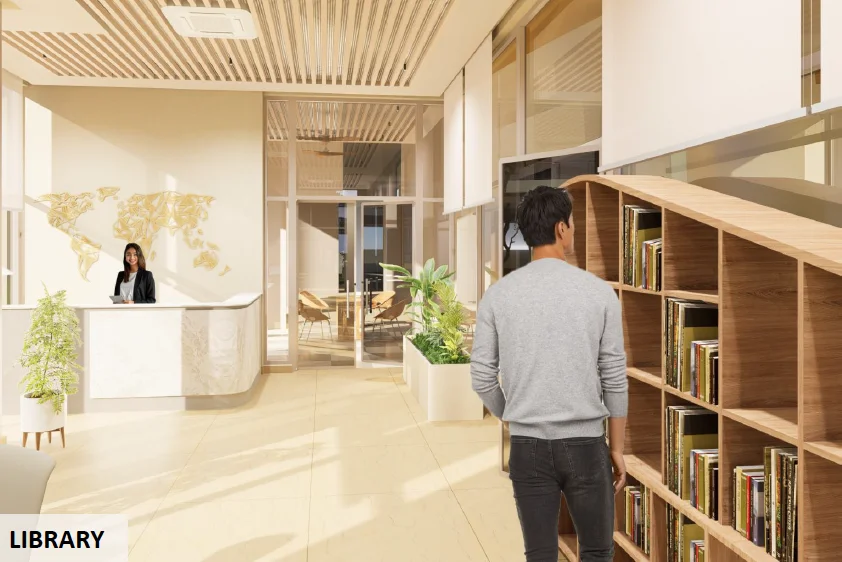
It is two-thirty on a Wednesday afternoon. The library is at half capacity. A teenager works on her SAT vocabulary at the long timber table, headphones in, a black coffee at her elbow. An older man in a grey kurta sits in the corner armchair, a hardback of Tagore open at page seventy-eight, the magnolia outside the window in mid-bloom. A young mother reads on the long bench seat against the south window while her four-year-old turns the pages of a Maurice Sendak picture book at her feet. A grandfather, two seats away, has fallen asleep over The Economist, his glasses still on. The room is silent except for the small sounds of paper.
One floor below, the co-working floor is at a different rhythm. A woman in her mid-thirties is on a video call in a focus pod, the door closed, the acoustic seal firm. Two men at hot desks are working on a deck for an investor pitch, their conversation low. The video-call booth is occupied by a freelance designer in a Tokyo-time call. A small contingent at the long shared desk are on their own laptops, deep in their own tasks, in the quiet group concentration that a serviced office produces and a domestic study cannot. The wifi indicator at the entrance shows enterprise speed. The printer hums. The day, in both rooms, has settled into its work.
This essay is about why both rooms exist, side by side, on the same floor of the same building. Why the library and co-working at Forbes Fab Luxe Residences are not redundant amenities but complementary architectures. Why the contemporary luxury apartment is no longer just a place to live; it is also a place to think, study, work, write, read and conduct a serious professional life. And why, in the post-pandemic Indian luxury market, this architectural pair is among the most decisive amenity decisions a residence can make.
The BriefOne room cannot do two architectures
The argument for separating the library from the co-working floor is the same architectural argument we have made elsewhere about the two pools and the purpose-built clubhouse rooms. A library and a co-working space are different architectures because they support different cognitive tasks. The library is a room for solitude — for slow reading, for deep concentration, for the unhurried inhabitation of a single text. The co-working floor is a room for productive society — for the focused work that benefits from a low-key social presence, the casual conversation, the printed handout, the meeting room, the video call.
A single multipurpose room cannot do both. The acoustic brief is opposed. The lighting brief is opposed. The furniture is opposed. The library wants soft warm light, deep armchairs, hardback books, paper periodicals, no screen blue, no phone speaker. The co-working floor wants cool task light, ergonomic seating, dual monitors, fibre wifi, printers, video booths, screen blue everywhere. The Fab Luxe brief refused the multipurpose compromise. Two rooms, two architectures, one floor. The corridor between them is short — twenty seconds — but the two atmospheres are fully separated.
What you'll find here
- Location2nd floor, Grand Clubhouse
- Library size~1,800 sq ft, planted views
- Books at launch~6,000 curated titles
- Children's cornerAdjacent, low shelves
- Reading nooksPrivate, single-occupant
- PeriodicalsNational + international
- Co-working size~2,400 sq ft, day-lit
- Hot desks~24 ergonomic stations
- Focus podsSix private, sound-isolated
- Meeting roomsThree, full AV
- Video boothOne, dedicated
- WifiEnterprise fibre
- PrintingFair-use included
- Hours6 AM – 11 PM (co-work)
- Library hours7 AM – 10 PM
- BookingResident app
Six thousand books, and a shelf that already has gravity
The library at Fab Luxe is a deliberately over-stocked room. It launched with approximately six thousand titles — not a token shelf, but a curated collection ranging across literary fiction, non-fiction, philosophy, history, science, biography, children's literature, and periodicals. The acquisition brief was that the launch shelf must already have gravity, so that residents donate into it rather than having to seed it. A donation of a treasured edition of Rabindranath Tagore from a resident in Tower 6 is more meaningful when it joins a shelf that already contains the Bharati Bhavan edition of Tagore than when it arrives in a half-empty room.
The room itself is approximately 1,800 sq ft. The geometry is deliberate. A long timber table at the north window for study and shared reading. A series of private reading nooks along the east wall, each with a single armchair, a low side table, a small directional reading lamp. The south wall is the children's reading corner — low shelves, a low table, a soft rug, a window seat — adjacent enough to the main hall that a parent can read in their corner while their child reads in theirs. The west wall holds the periodicals — The Economist, The New Yorker, The Hindu Magazine, Outlook, Open, Caravan, National Geographic, Granta, plus a rotating shelf of international magazines.
The lighting is layered. Ambient ceiling light at a warm 3000K, low-level. Directional task lights at each armchair and at the long table. A single skylight above the long table delivers diffused north light through most of the day. The acoustics are tuned — felt panels above the periodical shelves, an absorbent rug below the children's corner, a low timber-slat wall between the nooks and the long table. The room is, by design, the quietest room in the entire 35,000 sq ft clubhouse. The library brief specifically mentions the absence of background music. The room produces its own music — paper, breath, the occasional turning of a page.
The Co-Working FloorThe office that is not your apartment
The co-working floor at Fab Luxe was conceived in the immediate post-pandemic moment, when the Indian luxury market was rapidly absorbing the reality that a substantial fraction of its residents would, going forward, conduct their professional life from home. The Fab Luxe brief recognised that the apartment, however large, is not a perfect office. The kitchen is across the corridor. The children, on a school holiday, are visible. The Wi-Fi is residential-grade. The video call has a domestic background. The architectural argument for a separate co-working floor in the residence is that the working resident, three days a week, will benefit from a room that is professionally configured for work — without the friction of commuting to a Connaught Place serviced office.
The room itself is approximately 2,400 sq ft. The configuration is borrowed from the best of the international serviced-office practice. A central zone of approximately twenty-four hot desks — ergonomic chairs, dual-monitor capability, power and data at every station, ambient noise within forty-five decibels. Six private focus pods around the perimeter, sound-isolated to the standard of a recording booth, each with a desk, monitor, and locking door. A dedicated video-call booth at the corner. Three meeting rooms (four-seat, six-seat, and an eight-seat boardroom) with full audio-visual kit, video conferencing, and screen-sharing. A small refreshments counter with tea, coffee, water and basic snacks. A locker bank for residents who want to leave a laptop or paperwork on the floor for the week.
The fibre is enterprise-grade — symmetrical, redundant, with an SLA equivalent to a Tier 1 corporate office. The printer is a multifunction colour laser with secure print release. The acoustic brief is consistent with a serviced office — the hot-desk zone is configured as a low-noise area, with phone calls expected to take place in focus pods or in the dedicated phone-call corridor. The visual brief is muted — natural timber, cool grey upholstery, planted screens between zones, a single live-edge timber table at the entry. There is no domestic art. The room is a workplace.
Hours, booking, fees, and the assurance backbone
Both rooms operate under the Forbes 3-Year Assurance Programme. The co-working floor is staffed during all open hours by a community manager who handles desk allocation, meeting-room bookings, AV troubleshooting, printing, refreshments, and small operational issues. The library is staffed by a part-time librarian who manages cataloguing, donations, periodical rotation, children's storytelling sessions on Saturdays, and the gentle enforcement of the silent-room protocol after 8:00 PM.
Hours are published. Co-working: 6 AM to 11 PM, seven days a week, with 24/7 access for booked-desk holders during exam seasons and corporate sprints. Library: 7 AM to 10 PM daily, with a quieter evening protocol after 8 PM. Fees are simple. Both rooms are included in maintenance with no membership layer. Hot desks are no-charge for residents during ordinary use; meeting rooms beyond a generous resident allowance carry an internal tariff designed only to manage demand. Printing is included up to a fair-use threshold; bulk print runs are billed at internal rates. Library access is unrestricted; the children's corner is open through the day; the storytelling sessions on Saturdays are free for resident children.
Design IntentTwo rooms, one floor, one building
The architectural philosophy of the library and co-working pair rests on three principles. First: solitude and society are different cognitive states, and they require different rooms. The library is the solitude room; the co-working floor is the society room. Second: the two rooms must be physically separate but architecturally proximate, so that a resident can move from one to the other without leaving the floor. The corridor between them is twenty seconds long, but the acoustic and visual atmospheres are fully separated. Third: each room must be operated to a professional standard — the library managed by a librarian, the co-working by a community manager, both retained under the assurance programme for the first three years.
The fourth, less obvious principle is the relationship to the larger clubhouse. The library and co-working floor sit on the second floor of the clubhouse, alongside the cafeteria and the multipurpose hall. A resident finishing a morning's work in the co-working floor can, at lunch, walk thirty steps to the cafeteria, then thirty more to the library for an afternoon of reading. The architectural sequence — work, eat, read — is a single floor, a single building. That is the structural advantage of integrating the workspace into the residence rather than treating it as a separate amenity.
Global BenchmarksWhat the world's great residential libraries and workspaces got right
To benchmark the Fab Luxe library and co-working pair against international precedent, three references are useful. The residents' library at One Hyde Park, London — a curated, professionally-managed reading room with periodical rotation and event programming — established the principle that a residential library, given a proper brief, becomes one of the most-used amenities in any luxury building. The co-working amenity at Marina One, Singapore — enterprise-grade fibre, focus pods, meeting rooms — established the post-pandemic principle that residential co-working must operate to the same standard as commercial serviced offices. The residential business centre at Burj Khalifa Residences, Dubai, established that a multi-discipline professional workspace integrated into the residence reduces the resident's daily commute friction and compounds quality-of-life over decades.
According to the Urban Land Institute and International Council of Shopping Centers research on branded residences, the combination of a curated 6,000-title residential library with a professionally managed enterprise-grade co-working floor places Fab Luxe in the top decile globally for residential workspace provision. In the Indian residential market at the ₹2.96 Cr starting price, comparable enterprise-grade co-working integrated with a curated library is currently rare. The branded-residences index tracks workspace provision as one of the fastest-rising amenity drivers of price premium in 2025–2026.
A Tuesday in NovemberHow the two rooms actually behave
It is Tuesday at six-thirty in the morning. The co-working floor has just opened. Two early risers are at hot desks, working on a quarterly report due Thursday. The community manager is making coffee. The video booth has a Tokyo call scheduled for seven. By eight, the floor will be at half capacity — a small influx of professional residents arriving from the towers, laptops in messenger bags, on the way to a focused morning. By ten, the meeting rooms will be in active use. By noon, the cafeteria across the corridor will be drawing the floor for lunch.
One floor below, the children have already left for school. By eleven, the library is at its mid-morning occupancy — three retirees with newspapers, a graduate student writing her thesis at the long table, a young mother reading The New Yorker while her toddler sleeps in the children's corner. By two, the SAT students arrive. By four, the post-school children settle into the storytelling corner for the daily reading. By seven, the after-work readers — a few professionals taking the long armchair after a day at the co-working floor — settle in for the quiet evening. By ten, the room dims. The librarian closes the children's corner. The hardback books return to their shelves.
By eleven, the co-working floor empties. The community manager closes the meeting rooms, locks the focus pods, leaves the night-mode lights on for the rare 24/7 access holder. By midnight, the second floor of the clubhouse is silent. By 5:30 the next morning, the cycle resumes — the cafeteria opens, the early hot-desk holder arrives, the library prepares for its 7 AM opening. The library and the co-working floor — two rooms, two architectures, one residence — settle into another day of solitude and society in the same building.
That is the architecture of work-from-home in the Indian luxury 2026. Not a desk in the corner of the apartment. A room that is professionally configured for work, twenty seconds from a room that is professionally configured for reading, both included in maintenance, both managed by professionals, both within a 35,000 sq ft clubhouse, both within a 13-acre campus that, by ten in the evening, has gone quietly to sleep around them.
Walk both rooms in person.
A workspace walkthrough covers the residential library, the co-working floor, the focus pods, the meeting rooms, and the children's reading corner — with the community manager on hand to talk through booking, fibre and the children's storytelling schedule.
Schedule a Workspace Tour →Frequently Asked
What is inside the library at Forbes Fab Luxe Residences?
A professionally curated room with approximately 6,000 titles at launch — fiction, non-fiction, children's books, periodicals — pre-stocked, with private reading nooks, a long study table for SAT and exam prep, garden-view armchair seating, and a dedicated children's reading corner.
What does the co-working space include?
An enterprise-grade fibre, ~24 hot desks, six private focus pods, three meeting rooms with audio-visual kit, a dedicated video-call booth, printing facilities, locker storage, a refreshments counter, and a small phone-call corridor — to the standard of a serviced office.
Who can use the library and co-working spaces?
All residents of Fab Luxe have unrestricted access to both under maintenance. Children are welcome in the library children's corner. Co-working desks and meeting rooms are bookable through the resident app — typical workday sessions are no-charge, while extended meeting-room bookings carry small internal tariffs.
What hours are the library and co-working open?
Co-working: 6 AM to 11 PM seven days a week, with 24/7 access for booked-desk holders during exam seasons and corporate sprints. Library: 7 AM to 10 PM daily, with a quieter evening protocol after 8 PM. Both managed under the 3-Year Assurance Programme.
Are the library and co-working included in maintenance?
Yes. Library access, hot desks, focus pods and the regular co-working amenities are included in maintenance. There are no membership fees layered on top. Meeting-room bookings beyond a generous resident allowance carry an internal tariff designed only to manage demand.
How does the Fab Luxe library and co-working compare with global benchmarks?
The combination places Fab Luxe in the same conversation as the residents' library at One Hyde Park, the co-working amenity at Marina One in Singapore, and the residential business centre at Burj Khalifa Residences in Dubai. In the Indian market at the ₹2.96 Cr starting price, this combination is currently rare.
Can I take video calls from the co-working floor without disturbing others?
Yes. The co-working floor includes private focus pods designed for sound isolation during video calls, a dedicated video-call booth, and three bookable meeting rooms with full AV. The hot-desk zone is a low-noise area; the acoustic brief is consistent with a serviced office.
References
- Urban Land Institute (ULI) — Mixed-Use & Branded Residences research notes (2024)
- International Council of Shopping Centers (ICSC) — Branded Residences amenity benchmarks (2024–2025)
- Knight Frank / Savills Branded Residences Index, global tracking 2025
- JLL — Post-pandemic residential workspace research, India 2024–2025
- American Library Association — residential library cataloguing and curation guidelines
- Cross-network reference: Forbes Property — editorial on work-from-home in luxury residential
- Cross-network reference: Forbes Noida Extension — Greater Noida West professional-residence overview
- Cross-network reference: Forbes Flats — workspace amenities across luxury Greater Noida West projects