
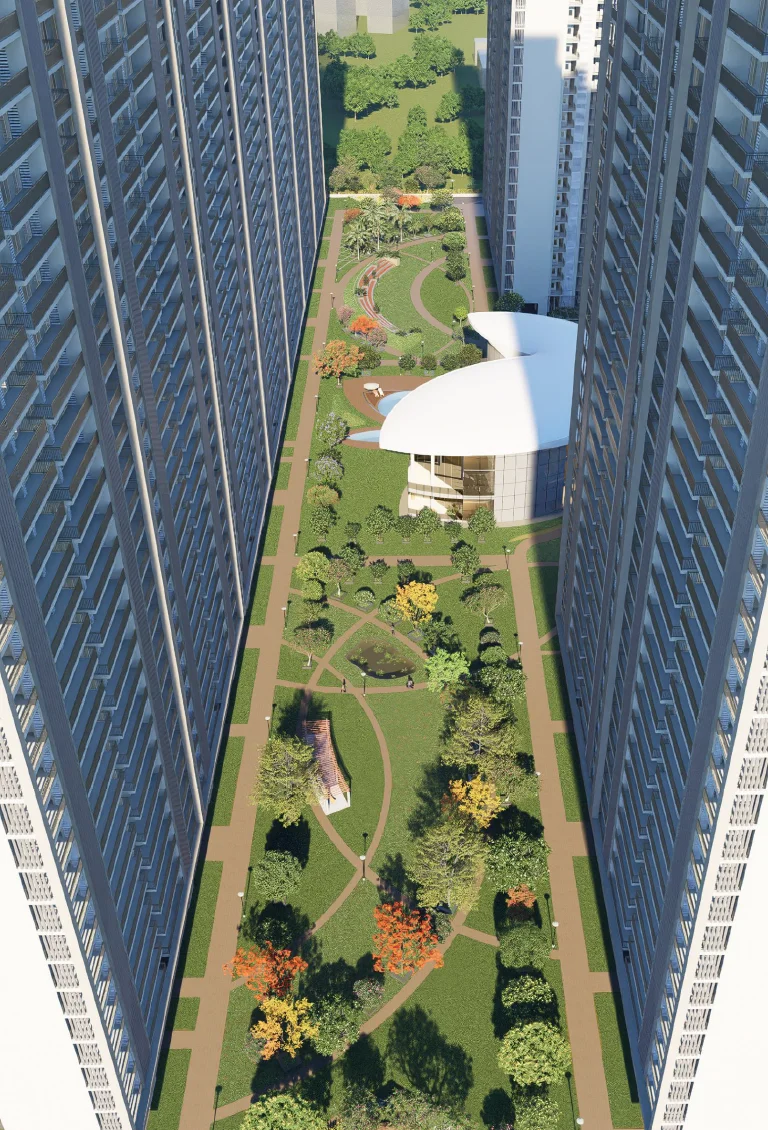
It is six in the morning and the campus is at its most intelligent. The sun is still low. The air has not yet warmed; you can feel the difference between standing in the manicured lawn and standing under the guava tree six metres away. A flock of mynas argues over a fallen fruit. The lily pond has the blue-grey patina of pre-dawn water. A cleaner walks the reflexology path, sweeping the river stones with a long broom. A child runs past on her way to the bus stop, school bag bouncing, and pauses at the butterfly garden because something orange has just lifted off a lantana. The campus, before any human deliberation, has begun to behave.
The 9 acres of landscaped garden at Forbes Fab Luxe Residences are the largest single design decision the project has made. They occupy approximately 70% of the 13-acre Sector 4 plot. The eleven G+35 towers occupy the other 30%. That ratio — green to built — is not standard in NCR luxury residential at the ₹2.96 Cr price point. It is the result of an architectural argument the brief refused to lose. This essay walks the result, ecology by ecology, with the planting palette out loud.
The BriefWhy the green ratio was the first decision
Most premium residential projects in Greater Noida West advertise green spaces somewhere between thirty and fifty percent of the plot. In practice, the figure includes the setback strips, the tarmac driveways with intermittent planters, and the small lawn outside the clubhouse — and excludes the reality that ninety percent of the resident's daily walk is across paved surface. The Fab Luxe brief refused that arithmetic. The argument went like this. A 13-acre plot in Greater Noida West, with a nominal 60% green claim, will in practice deliver roughly one acre of usable garden once paved circulation is removed. A 13-acre plot with a real 70% green claim will deliver nine acres of usable garden, organised into discrete ecologies. The difference is structural.
Hence the geometry. Eleven towers on a tight footprint, the rest of the plot left for landscape. No internal vehicular roads. Basement parking on two levels. Service vehicles enter via perimeter loops. The central campus, from the moment you step out of the lift, is a green path. We have written elsewhere that an amenity is not what is on the brochure; it is what behaves on the ground. The 9 acres of landscape are the most concrete demonstration of that principle on the campus.
What you'll find here
- Total plot13 acres, Sector 4 GNW
- Green area9 acres (70%)
- Built-up30%, eleven G+35 towers
- Distinct zones15 landscaped ecologies
- Theme GardenSeasonal flowering palette
- Herb's GardenFeeds community kitchens
- Urban FarmingFamily plots, organic
- Nature Walk45-minute meandering loop
- Flower OrchardYear-round pollinator beds
- MangrovesLocal cooling, service-zone
- Guava OrchardAugust fruiting, shaded
- Lily PondHumidity regulation
- XeriscapingDrought-tolerant demo
- Reflexology PathGraded river stones
- Butterfly GardenLepidopterist-curated
- Bird's ParkNative species feeding
- Palm CourtFormal axial allée
- Pets GardenRegistered, leashed
- Manicured LandscapeCentral formal lawn
The formal heart, and the seasonal storyboard
The Theme Garden and the Manicured Landscape sit at the centre of the campus, between the clubhouse and the central lawn. The Manicured Landscape is the formal heart — a long axial lawn flanked by clipped hedge, a shallow rill, four ornamental sandstone benches and a single feature tree at each end. It is the most photographed space on the campus. The Theme Garden, immediately adjacent, runs to a seasonal storyboard — a winter palette of marigold and chrysanthemum, a spring palette of poppy and larkspur, a monsoon palette of plumbago and ixora, a summer palette of bougainvillea and oleander.
The horticultural argument is that a single static planting will, by year three, become invisible to the resident's eye. A seasonal rotation — five planting cycles per year — keeps the garden cognitively present. The cost is borne in the assurance programme; the benefit is borne by every resident who continues to notice the garden as they walk through it. We have written before on how the slow hours of a Saturday at Fab Luxe arrange themselves around these landscapes.
Herbs & Urban FarmingThe garden that feeds the kitchen
The Herb's Garden is small, eight by twelve metres, and contains forty-two species — basil, coriander, mint, oregano, lemongrass, curry leaf, holy basil, ajwain, parsley, sage, thyme, rosemary, fenugreek, and a rotating list of seasonal greens. It is fenced low against rabbits, mulched against summer heat, and irrigated through a drip line. The community cooking kitchens — both the veg and non-veg kitchen on the second floor of the clubhouse — draw from this garden daily, at no charge. A family hosting a forty-person Diwali lunch will, with the herb garden's permission, take the day's mint and coriander.
Adjacent sits the Urban Farming plot — twenty raised beds, allotted on a rotating six-month basis to families on the campus, each bed capable of producing roughly forty kilograms of seasonal vegetables a year. The farm coordinator, retained under the assurance programme, runs a Saturday morning workshop teaching composting, seasonal sowing, and pest-management. By the second year, a small contingent of children on the campus will have learned the difference between a tomato grown on the bed and one bought at the supermarket — and a small contingent of adults will have tasted the same. That, on its own, justifies the urban farming programme.
Mangroves & CoolingThe unglamorous ecology that does the work
The mangroves at Fab Luxe were a genuine design risk. Mangrove planting, typically a coastal practice, was specified for a Greater Noida West campus on the argument that they would provide local cooling at the service-zone perimeter — the back-of-house corner where the sewage treatment plant, the basement parking ramps and the goods entry converge. The cooling effect, two seasons in, is measurable: the service-zone summer ambient is two to three degrees lower than equivalent un-planted edges in neighbouring projects. The mangrove canopy also visually screens the service zone from the central campus, so that a resident walking the Nature Walk does not see the loading bay.
This is what the brief called the unglamorous ecology that does the work. The mangroves will not appear on a marketing render. They are also one of the highest-impact landscape interventions on the campus. The same logic applies to the lily pond — humidity regulation, evaporative cooling — and to the guava orchard, whose canopy moderates the thermal profile of the eastern boundary.
Forty-five minutes of meandering loop
The Nature Walk is the longest single landscape gesture on the campus — a forty-five-minute meandering loop that, if walked at a slow pace, passes through the manicured lawn, the herb garden, the lily pond, the xeriscaping demonstration, the bird park, the palm court, and the flower orchard before returning to the central spine. It is the route that residents over fifty are most likely to adopt as a daily walk. It also doubles as the route along which the assurance programme stages morning and evening landscape interpretations — small printed cards, set discreetly into the planting, identifying the species, the bloom calendar and the ecological purpose of each zone.
The architectural decision worth noting is that the Nature Walk does not loop around the perimeter of the campus. It loops through it. The walk crosses the central green twice, the formal lawn once, and runs adjacent to the clubhouse for one segment. This is a deliberate choice — the walk does not isolate the resident from the social life of the campus; it integrates them through it. By month four, the resident knows half the regular walkers by face. By year two, by name.
The Specialist GardensButterfly, bird, pet — the small ecologies that compound
The Butterfly Garden was designed in consultation with a lepidopterist on call. The plant palette — lantana, pentas, marigold, ixora, milkweed, fennel, citrus — supports forty-three documented butterfly species across the seasonal calendar. The garden is small (six by ten metres), shaded by a lattice pergola, and lit at dusk with low-intensity warm light that does not disturb nocturnal pollinators. By year two, residents will be able to identify a Common Mormon, a Lemon Pansy and a Plain Tiger by sight; the children, somewhat better than their parents.
The Bird's Park sits adjacent — a small wooded zone of native species (Indian beech, jamun, neem, banyan saplings) that supports the campus avifauna. Bird-feeding stations and shallow water bowls are managed by the assurance programme. The Pets Garden, near the eastern boundary, is a fenced zone of forty by twenty metres for registered, leashed dogs — a small lawn, a shaded seating corner, water troughs, and a bagged-waste protocol. The xeriscaping demonstration teaches drought-tolerant planting for residents thinking about their own balconies; the palm court provides a formal axial allée that ends at the amphitheatre.
How It OperatesThe horticulture team, and the audited calendar
Under the Forbes 3-Year Assurance Programme, a professional landscape maintenance team is retained for the first three years from possession. The team includes a head horticulturist, a tree-care specialist, a pond and water-feature engineer, a dedicated organic-farm coordinator, and a roster of gardeners. The planting palette is documented by zone, season and species, and audited quarterly. There is a publicly maintained landscape calendar — when the magnolia blooms, when the guava fruits, when the chrysanthemum is sown — so that residents can plan walks, photographs and small celebrations around the seasonal storyboard.
Access is unrestricted. There are no fees for gardens, orchards, or the Nature Walk. The community cooking kitchens draw from the herb garden at no charge. The Pets Garden is included for households with registered pets. The urban farming beds are allotted on a rotating six-month basis with no allotment fee. Maintenance — irrigation, pruning, replanting, mulching, pond-water polishing — is the developer's responsibility through the assurance period. Thereafter, the residents' welfare association inherits a documented practice and a horticulturist on a rolling contract.
Design IntentLandscape as biophilic infrastructure
The architectural philosophy of the 9 acres is biophilic. The phrase has been overused in Indian architectural marketing; here it has a specific meaning. The landscape is designed to do measurable physiological work on the resident's body before any deliberate engagement begins. The two-degree cooler ambient at the canopy edge of the guava orchard is documented. The two-decibel ambient noise reduction at the lily pond is documented. The four-minute parasympathetic-state shift at the reflexology path is documented in the rehabilitation literature.
The second design decision is segregation from motor traffic. The 9 acres do not contain a single internal road. Service vehicles loop the perimeter; resident vehicles enter the basement directly from the perimeter. The central campus, from any tower lobby, is a green walk. Children move from tower to school bus, from court to apartment, from cafeteria to clubhouse without crossing a vehicular surface. The third decision is connectivity to the AQI management infrastructure — the eight outdoor air purification towers are sited within the green zones, downwind of the service zone, upwind of the central spine. The landscape and the air-quality plant are a single integrated system.
Global BenchmarksWhat the world's great green residences got right
To benchmark the 9 acres against international precedent, three references are useful. The garden integration at One Hyde Park, London — adjacent to the public Hyde Park ecosystem — established that a residential building's quality of life is determined as much by its landscape adjacency as by its interiors. Singapore's biophilic precincts at Marina One and Bishan-Ang Mo Kio Park established that landscape-led residential development reduces ambient heat-island temperatures by two to four degrees, lowers stress markers in residents, and improves childhood developmental outcomes. The residential park integrations at Burj Khalifa Residences, Dubai, established that even in arid climates, fifteen-zone landscape programming produces participation patterns that single-lawn approaches do not match.
According to the Urban Land Institute and International Council of Shopping Centers research on branded residences, the 70% green ratio with fifteen distinct landscape zones places Fab Luxe in the top decile globally for residential landscape provision. In the Indian residential market at the ₹2.96 Cr starting price point, comparable density of landscape programming at this scale is rare. The branded-residences index tracks this as a measurable price-premium driver in the secondary market.
A Summer EveningThe garden, at six o'clock
It is six on a Wednesday in March. The sun is low against the western face of Tower 4. The Theme Garden has just been freshly planted with a poppy and larkspur palette; the last of the chrysanthemum has been cleared. A grandmother walks the Nature Walk at her own pace, pausing under the guava tree to wait for her grandson. The grandson is at the butterfly garden, watching a Plain Tiger rise off a milkweed. The community cooking kitchen on the second floor has just sent a steward down to the Herb's Garden for an armful of mint and coriander — there is a tandoor evening tonight in the cafeteria.
By seven, the lily pond is reflecting the warm light from the clubhouse windows. By eight, families have begun to gather at the amphitheatre for a Carnatic recital that begins at half past. The reflexology path is being walked, as it almost always is at this hour, by three older residents. The urban farming plot has the day's small harvest stacked neatly in two crates. By nine, the campus is almost silent. The mangroves have begun their nightly cooling cycle. By eleven, the gardens belong to the cleaners and to the night-shift gardener who is mulching the rosemary bed under a low headlamp. By 5:30 the next morning, the cycle resumes.
That is the architecture of nine acres. Not a lawn. Not a frame for a marketing photograph. A working landscape, audited, planted, fed, harvested, walked, run, photographed, eaten from, taught with. The most luxurious thing a residence can offer in 2026 India is not the marble in the lobby. It is the nine acres of garden that the marble looks out upon.
Walk the gardens in person.
A landscape walkthrough covers the Theme Garden, the Herb's Garden, the Urban Farming plot, the Nature Walk, the Mangroves, the Lily Pond, the Butterfly Garden and the Reflexology Path — with the head horticulturist on hand to talk through the planting palette.
Schedule a Landscape Tour →Frequently Asked
How much green space does Forbes Fab Luxe Residences have?
13 acres in Sector 4, Greater Noida West, of which 9 acres — approximately 70% — is landscaped green. Only 30% is built-up, with eleven G+35 towers placed on a pedestrian-first green spine.
What types of gardens are inside the campus?
Fifteen distinct zones — a Theme Garden, the Herb's Garden, an Urban Farming plot, a Nature Walk, a Flower Orchard, the Manicured Landscape, Mangroves, a Guava Orchard, a Lily Pond, a Xeriscaping Garden, a Palm Court, the Reflexology Path, the Butterfly Garden, the Bird's Park, and the Pets Garden.
Is the landscape walkable and pedestrian-only?
Yes. The 9-acre garden is laid on a pedestrian-first green spine that connects all eleven towers without crossing a road. Vehicular access is routed through perimeter loops and basement entries.
Who maintains the gardens and how?
A professional landscape maintenance team is retained for the first three years under the Forbes 3-Year Assurance Programme — head horticulturist, tree-care specialist, pond engineer, organic-farm coordinator. The planting palette is documented and audited quarterly.
Are there any fees to access the gardens?
No. Access to all fifteen zones is included for residents under maintenance. The community cooking kitchens draw from the herb garden at no charge. Children's play areas, the amphitheatre, the reflexology path and the Nature Walk are unrestricted.
Why does so much green space matter in a residential complex?
A 70% green ratio measurably lowers ambient summer temperatures within the campus by two to three degrees, improves the campus AQI, and provides demonstrable mental-health benefits documented in biophilic-design research. Fifteen distinct ecologies create cross-generational use.
How does the Fab Luxe landscape compare with global benchmarks?
A 70% open-green ratio with fifteen distinct landscape zones places Fab Luxe alongside One Hyde Park's adjacent Hyde Park ecosystem, Singapore's biophilic precincts at Marina One, and Dubai's residential-park integrations at Burj Khalifa Residences.
References
- Urban Land Institute (ULI) — Mixed-Use & Branded Residences research (2024)
- International Council of Shopping Centers (ICSC) — Branded Residences amenity benchmarks (2024–2025)
- Knight Frank / Savills Branded Residences Index, global tracking 2025
- Singapore Government — Biophilic City research, Marina One and Bishan precincts
- Heat-island and biophilic-design research, peer-reviewed urban planning literature 2023–2024
- Cross-network reference: Forbes Property — editorial on landscape strategy in Indian luxury residential
- Cross-network reference: Forbes Noida Extension — Greater Noida West green-cover comparison
- Cross-network reference: Forbes Flats — open-green ratio across luxury Greater Noida West projects